




Published 27/09/2026 · Updated 27/09/2026 · By Voldt® product team
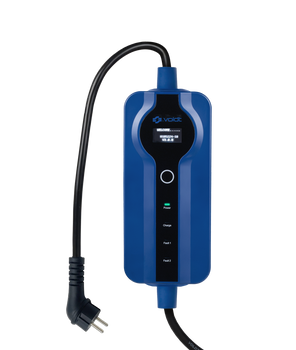
HMRC lets an employer repay the electricity used to charge a company car at home without a benefit-in-kind charge, as long as it can show the electricity went into that car. A record of each charging session is the simplest proof (HMRC Employment Income Manual, EIM23900). A portable 3-pin charger that logs every session in its app gives the driver that record from an ordinary socket.

Voldt® app · session log
Plugged in
21:40
Unplugged
06:10
Current
10 A
User
Driver 1
Total
energy
19,6kWh
Duration
8 h 30 min
✓ Saved in the Voldt® app
Key points
Home-charging claim
Example
kWh, company car only
19,6 kWh
from the charger
Date and time
27/09, 21:40 to 06:10
from the charger
Driver
Driver 1
from the charger
Price per kWh
£ ___ per kWh
agreed by you
01 · Company cars
Why are more UK fleets moving to fully electric cars?
Because company car tax on plug-in hybrids jumps to 18% in April 2028, while fully electric cars rise to 7%.
Benefit-in-kind rates for fully electric company cars are set at 4% for 2026/27, 5% for 2027/28, 7% for 2028/29 and 9% for 2029/30 (HM Treasury). Plug-in hybrids with 1 to 50 g/km of CO2 are banded by electric range until April 2028, then move to a flat 18%, rising to 19% in 2029/30.
Fig. 1
Company car tax by tax year

fully electric
plug-in hybrid, 70 to 129 miles electric range
HM Treasury company car tax rates to 2029/30.
For a car on a four-year lease signed now, that step lands in the second year, so a hybrid ordered today costs its driver more in tax before the lease ends. Each fully electric car that charges at home adds a bill on the employee's own supply, and the employer needs the car's share of it, separated from the household's.
02 · HMRC
Can an employer repay home charging of a company car tax-free?
Yes, under section 239 of ITEPA 2003, provided the employer can show the electricity was used for the company car.
HMRC changed its guidance in 2023: repaying part of a domestic energy bill used to charge a company car or van falls within the exemption in section 239 of the Income Tax (Earnings and Pensions) Act 2003. No benefit in kind arises, whether the miles are private or business (EIM23900). The condition is proof that the electricity went into the company car.
The alternative is the advisory electricity rate: from 1 September 2026, 7p per business mile for home charging and 15p for public charging (HMRC advisory fuel rates). It needs no meter reading, but it covers business miles only, and commuting counts as private travel.
Fig. 2
Two ways to repay home charging
Advisory electricity rate
7p
per business mile
No meter reading needed
Business miles only, no commuting
Actual electricity cost
Every kWh
the company car took at home
Private and business miles
Needs a record per session
HMRC advisory fuel rates, 1 September 2026; HMRC EIM23900.
With a record per session, the employer can repay every kWh the company car took at home at the driver's unit rate. At the Ofgem price cap of 26,32p per kWh for October to December 2026, a 20 kWh charge costs £5,26.
Voldt® tip
Put the rate in the car policy when you hand over the car: the driver's unit rate, or a fixed pence-per-kWh figure you review each quarter. With the kWh coming from the charger, the rate is the only number left to agree.
03 · Measuring
Why can't the smart meter or the car's app settle the bill?
The smart meter records the whole house, and the car's app counts only what reached the battery, after charging losses.
A smart meter shows when electricity was used, but not which part went into the car. Any split of the household total is an estimate, and an estimate is hard to defend as proof that the electricity went into the company car. The meter also cannot tell a company car from a second, private car on the same drive.
The car's app measures after the losses in the car. In a German test by the motoring club ADAC, five current EVs lost 12,7 to 24,2% of the electricity drawn from a 2,3 kW household socket before it reached the battery; at an 11 kW wallbox the loss was 5,1 to 7,0% (ADAC, August 2026). Repaying from the car's app underpays the driver by that share.
Fig. 3
Where 100 metered kWh end up
Household socket
2,3 kW
Wallbox
11 kW
reaches the battery
lost in some cars
lost in every car
Measured in Germany: ADAC test of five EVs, 10 to 90%, published 6 August 2026.
The charger's control box measures before the car, so the losses in the car are part of the logged kWh, as they are on the electricity bill. A 3-pin socket at 10 A draws the same 2,3 kW as in the ADAC test, so charging from it matches the household-socket panel in Fig. 3.
04 · Records
How does a charging session reach payroll?
The charger logs each session in the Voldt® app, and the driver exports the log for the monthly claim.
The Voldt® app connects to the charger over Wi-Fi or Bluetooth and keeps a session history with the energy of every charge. Several users can be linked to one charger, each with an individual usage log, so a pool car or a shared drive keeps the sessions apart. The records export for expense claims.
Fig. 4
From the drive to the payslip
Charger
Control box measures the kWh
App
Session history per user
Export
Monthly log for the claim
Payroll
Repaid with salary
Logged for every session: ● kWh ● date and time ● user
Voldt® 3-pin portable charger specification.
This route suits fleets that handle expense claims monthly, and it needs no back-office contract. A fleet that wants sessions to flow into a fleet platform on their own needs a charge point that speaks OCPP, the open protocol between charge points and back-office software.
Voldt® tip
Link every driver to the charger in the app before you hand it over, and agree the export date, for example the first working day of the month. A session logged under the wrong user makes a claim hard to check.
05 · Charging time
How long does a 3-pin socket take?
At up to 2,8 kW, a 3-pin socket adds about 20 kWh in seven hours, enough for most overnight top-ups but slow for high mileage.
The charger adjusts between 8 A and 13 A on its own, depending on the load on the circuit, or you set the current in the app or on the control box. At 13 A it draws up to 2,8 kW; at 10 A about 2,3 kW. For a car that does 3,5 miles per kWh, 20 kWh covers around 70 miles.
Fig. 5
Hours to draw 20 kWh, starting at 20:00
7,1 h
3-pin socket at 13 A
2,8 kW
8,7 h
3-pin socket at 10 A
2,3 kW
10,9 h
3-pin socket at 8 A
1,8 kW
2,7 h
Wallbox, single-phase
7,4 kW
Power at 230 V; rated maximum 2,8 kW at 13 A.
Most UK homes are single-phase, so a fixed wallbox tops out at 7,4 kW, about two and a half times the 3-pin maximum. For a driver who covers long distances every day, that difference decides the choice; a commute of up to about 60 miles a day fits in one overnight session.
Voldt® tip
Use the 13 A setting only on a socket on its own circuit that an electrician has checked. On any other socket, keep the charger at 10 A, and check after an hour that plug and socket are no more than warm.
06 · Choice
When is a portable charger a better choice than a wallbox?
When a wallbox cannot or should not be fitted, or when the car, the driver or the address may change during the lease.
A wallbox needs an installation, a place on the wall and, in rented homes, the landlord's consent. When the employee leaves, someone has to remove it or buy it out. The portable charger needs none of that and moves with the car, which suits renters, drivers who may change job within the lease and pool cars.
For a driver with a drive and high mileage, a fixed wallbox remains the better option. A mixed fleet can use both: wallboxes for long-term drivers who own their home, portable chargers for renters, pool cars and anyone likely to move. If every session should reach a fleet platform without exports, choose OCPP wallboxes for those drivers.
Our verdict
Repay home charging of a company EV from a record per session, because that is the proof the section 239 exemption asks for. The portable 3-pin charger gives renters, leavers and pool-car drivers that record without an installation, and a fixed OCPP wallbox is faster and sends sessions automatically for high-mileage drivers with a drive.
01
Link each driver in the app first
02
Put the kWh rate in the car policy
03
Keep 13 A for a checked, dedicated socket
Buy it if
your drivers charge at home without a wallbox, rent or share cars, and a monthly export suits your payroll
Skip it if
you need sessions sent to a fleet platform automatically, or your drivers cover high mileage from a home with a drive
Voldt® 3-pin portable charger
Voldt® 3-pin portable charger with app
Current
8 to 13 A
Power
up to 2,8 kW
Plugs
3-pin to Type 2
Session log
kWh per charge, per user
Lengths
5, 10, 15 or 20 m
CE, UKCA and TÜV certified · IP67 · 3-year warranty · 100-day returns
Safe use and warranty
- Plug the charger straight into a sound, earthed 3-pin socket, never an extension lead or adaptor.
- Use the 13 A setting only on a socket on its own circuit that an electrician has checked.
- Where your car's manual differs from this guide, follow the manual.
Voldt® cables and portable chargers are CE and UKCA marked and TÜV certified, with a 3-year warranty; terms and exclusions are on the warranty and complaints page.
CE · UKCA · TÜV · IP67 · 3-year warranty · 100-day returns
Frequently asked questions about repaying home charging
Is repaying home charging of a company car a taxable benefit?
No, when the payment covers electricity used for the company car and the employer can show it (HMRC EIM23900, section 239 ITEPA 2003).
What is the advisory electricity rate from September 2026?
7p per business mile for home charging and 15p for public charging, for fully electric company cars.
Does commuting count as business mileage?
No. Home-to-work travel is private use, so the advisory rate does not cover it; repaying the electricity used under section 239 does.
Does the charger need a wallbox or an installation?
No. It plugs into a 3-pin socket; have an electrician check the circuit before you charge on it every night.
Can two drivers share one charger?
Yes. Several users can be linked to one charger, each with their own usage log in the app.
Can the sessions go straight into a fleet platform?
Not from this charger, whose records are exported from the app. For automatic transfer, choose a charge point that speaks OCPP.
Voldt® product team, product development and support
Develops Voldt® charging cables and portable chargers and answers the questions that reach Voldt® support.