




Authentic buyer
Solid item
Delivered on time. It is easy to use and works very well.


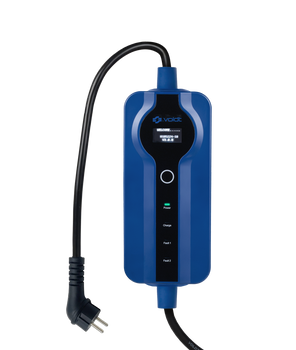
This collection holds two different things under one heading. A granny charger plugs into an ordinary three pin socket and delivers 2.8 kW. A portable charger with a commando plug uses an industrial socket and delivers between 3.7 and 22 kW from a unit you can still carry. They look similar, they are priced within about thirty pounds of each other, and they are not interchangeable — because the difference is not the charger, it is the socket you plug it into.
Dernière mise à jour : October 2026
| Unit | Socket required | Power | From |
|---|---|---|---|
| 3 Pin EV granny charger, 8–13 A, with app | Standard three pin domestic | 2.8 kW | £159.00 |
| 3 Pin to Type 1 portable charger, 8–13 A | Standard three pin domestic | 2.8 kW | £146.00 |
| Commando, 1 phase, 8–16 A, with app | Blue commando 16 A | 3.7 kW | £164.00 |
| Commando, 1 phase, 8–32 A, with app | Blue commando 32 A | 7.4 kW | £190.00 |
| Commando, 3 phase, 8–16 A, with app | Red commando 16 A | 11 kW | £224.00 |
| Commando, 3 phase, 8–32 A, with app | Red commando 32 A | 22 kW | £233.00 |
The step from the three pin granny charger to the 32 A single phase commando unit is £31.00, and it takes the output from 2.8 kW to 7.4 kW — two and a half times the speed for under twenty per cent more money. The catch is not the charger. It is that the commando unit needs a commando socket, which means an electrician; the granny charger needs nothing at all.
The arithmetic is worth doing once, because it settles most of the argument about whether a granny charger is "too slow". At 2.8 kW, a twelve hour overnight session delivers 33.6 kWh. On a 60 kWh battery that is more than half the pack, every night, from a socket that was already on the wall.
Whether that is enough depends entirely on how far you drive between charges, not on the headline figure. If you arrive home most evenings having used less than 30 kWh, a granny charger keeps up indefinitely and the faster unit buys you nothing. If you routinely arrive near empty and need a full pack by morning, it will not, and the commando route or a wallbox is the honest answer.
Prices on voldt.co.uk track exchange rates and are refreshed regularly, so the figures above are a snapshot taken on 7 October 2026 rather than a fixed list. The differences between units are far more stable than the absolute numbers: check the product page for today's price.
The decision is not really about the charger. Every unit in this collection adjusts its current, carries its own protection electronics and works out of the box. What differs is the socket at the other end, and whether you already have one.
| Socket | Power | Already in most homes? | What it takes to add |
|---|---|---|---|
| Three pin domestic | 2.8 kW | Yes | Nothing |
| Blue commando, 16 A | 3.7 kW | No | Electrician, single phase |
| Blue commando, 32 A | 7.4 kW | No | Electrician, single phase, spare capacity on the board |
| Red commando, 16 A | 11 kW | No | Three phase supply, uncommon in UK homes |
| Red commando, 32 A | 22 kW | No | Three phase supply, uncommon in UK homes |
That last column is the part worth reading twice. The two red commando units cover 11 and 22 kW, and they are the cheapest route to those speeds — but they need a three phase supply, which most British homes do not have. They earn their place on a farm, a workshop, a yard or a commercial unit, and rarely on a suburban driveway.
Every portable unit in this collection adjusts between 8 A and its maximum. On a wallbox that setting is a convenience; on a three pin socket it is the main safety control. A domestic socket and the wiring behind it were designed for intermittent loads, not for drawing near their limit for twelve hours straight. Turning the charger down to 8 or 10 A reduces the heat in the socket and the cable run, at the cost of a slower charge.
That is the practical reason to have the adjustment on the charger itself rather than buried in a car menu: the right setting depends on the socket you are standing in front of, which changes when you travel.
The accessory list includes adapters in both directions — Type 2 to a Schuko outlet at £129.00, a 16 A five pole commando to Type 2 at £90.00, a Type 2 to 16 A commando cable from £138.00. They solve genuine problems, usually abroad or on a site with the wrong socket fitted.
An adapter is rarely the economical way into a different socket type. At £129.00 to £139.00 the adapters sit close to the price of a second charger built for that socket, and each one adds a connection to the chain. They earn their keep when you already own the unit and meet the other socket occasionally — not as a substitute for buying the right unit in the first place.
| Characteristic | Detail |
|---|---|
| Charging mode | Mode 2: the control and protection electronics sit in the unit itself |
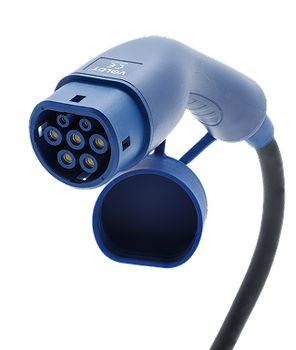
| Car-side connector | Type 2, or Type 1 on the dedicated three pin to Type 1 unit |
| Supply-side plug | Three pin domestic, or blue and red commando |
| Adjustable current | 8 A up to the maximum of each unit |
| Housings | IP67 rated: dust tight and protected against temporary immersion |
| Certification | CE and TÜV certified |
| App | Supplied with every unit except the three pin to Type 1 model |
| Manufacture | Built in Europe |
The 3 Pin to Type 1 unit at £146.00 is the only one in the range without app control, and it is also the only one with a Type 1 connector. Type 1 is the older single-phase standard, still found on imported and earlier models such as some Leafs, Outlanders and Ampera-era cars. If your car has a Type 1 inlet, this is the unit; if it has Type 2, it is not, and no setting changes that.
The Boxx matters more than it looks on a page. A portable charger left plugged in outdoors is exposed to weather and to opportunistic removal; a fixed housing turns a unit designed to travel into something closer to a permanent installation, without the installation.
From-prices as listed on voldt.co.uk on 7 October 2026. Prices on the UK site follow exchange rates and are refreshed regularly, so treat these as a snapshot and check the product page before ordering.
| Product | Power | From |
|---|---|---|
| 3 Pin to Type 1 EV portable charger, 8–13 A | 2.8 kW | £146.00 |
| Voldt® 3 Pin EV granny charger, 8–13 A, with app | 2.8 kW | £159.00 |
| Voldt® portable charger, commando, 1 phase, 8–16 A | 3.7 kW | £164.00 |
| Voldt® portable charger, commando, 1 phase, 8–32 A | 7.4 kW | £190.00 |
| Voldt® portable charger, commando, 3 phase, 8–16 A | 11 kW | £224.00 |
| Voldt® portable charger, commando, 3 phase, 8–32 A | 22 kW | £233.00 |
| Voldt Booster EV Set | — | £431.00 |
| Voldt Booster German Traveller Set | — | £475.00 |
| Voldt Booster EU Traveller Set | — | £587.00 |
| Voldt Booster Master Traveller Set | — | £673.00 |
| Voldt® Sitecharge, Type 2, 2× 11 kW | 2× 11 kW | £1,640.00 |
| Voldt® Sitecharge, Type 2, 2× 22 kW | 2× 22 kW | £1,640.00 |
Three steps, and they are not evenly spaced. From the three pin granny charger to the 32 A single phase commando unit is £31.00 for two and a half times the power — the best value step in the range, if you can use the socket. Between the two three phase units, 11 kW and 22 kW, the gap is £9.00, so there is little reason to choose the slower one where three phase exists. The Type 1 unit sits £13.00 below the Type 2 granny charger, which reflects the missing app rather than a different class of product.
Shipping is free, and returns are accepted within 100 days.
The two Sitecharge units are listed at the same £1,640.00 for 2× 11 kW and 2× 22 kW. If you have the three phase supply to use it, the 22 kW version is the one to order at that price.
The terms stated on voldt.co.uk are:
A hundred days covers more than a trial: it is long enough to run a charger through a full billing cycle and see what it actually adds to the meter, and long enough to find out whether 2.8 kW keeps up with how you really drive rather than how you expected to.
At 2.8 kW, a twelve hour session delivers about 33.6 kWh. On a 60 kWh battery that is more than half the pack in one night. Whether that is enough depends on how far you drive between charges rather than on the headline figure: if you use less than 30 kWh on a typical day, a granny charger keeps up indefinitely.
A granny charger is the version that plugs into a standard three pin domestic socket and delivers 2.8 kW. The other portable chargers in this collection use industrial commando sockets and deliver 3.7 to 22 kW. The electronics are comparable; what differs is the plug on the supply side and therefore the power available. On voldt.co.uk the three pin unit starts at £159.00 and the 7.4 kW commando unit at £190.00.
Only if you have the socket or can have one fitted. The £31.00 step from the three pin unit to the 32 A single phase commando unit takes you from 2.8 kW to 7.4 kW, which is excellent value for the hardware — but the socket itself needs an electrician, and that cost is not in the £31.00. If no commando socket exists and none is planned, the granny charger is the whole of the decision.
Many people do, and the arithmetic above is the test. It works when your daily consumption is comfortably below what an overnight session returns, and when you can leave the car plugged in for long stretches. It does not work if you regularly arrive near empty and need a full battery by morning, or if you can only plug in for an hour or two at a time.
Because the right setting depends on the socket, not on the car. A domestic socket and the wiring behind it were designed for intermittent loads rather than a twelve hour draw near their limit. Turning the unit down to 8 or 10 A lowers the heat in the socket and the cable run and charges more slowly. On an unfamiliar or older socket, the lower setting is the sensible default.
That is set by the inlet on your car and cannot be changed by a setting. Type 2 is the European standard and is on almost every recent electric and plug-in hybrid model. Type 1 is the older single-phase standard, still found on imported and earlier cars. Voldt® lists a dedicated 3 Pin to Type 1 unit from £146.00 for those vehicles.
The units are IP67 rated, meaning dust tight and protected against temporary immersion, so weather alone is not the obstacle. The practical issue is leaving a portable device unattended outdoors between sessions. The Voldt® Boxx, from £86.00, is a housing made for exactly that: it keeps the unit in place and sheltered without turning it into a fixed installation.
Three years, with free shipping and returns accepted within 100 days. The units are CE and TÜV certified, IP67 rated and built in Europe.
