Skip to content
Badge
Voldt® Portable EV charger commando plug | 3 phase | 8A - 16A | 11kW + APP Voldt® Portable EV charger commando plug | 3 phase | 8A - 16A | 11kW + APP Voldt® Portable EV charger commando plug | 3 phase | 8A - 16A | 11kW + APP Voldt® Portable EV charger commando plug | 3 phase | 8A - 16A | 11kW + APP Voldt® Portable EV charger commando plug | 3 phase | 8A - 16A | 11kW + APP Voldt® Portable EV charger commando plug | 3 phase | 8A - 16A | 11kW + APP Voldt® Portable EV charger commando plug | 3 phase | 8A - 16A | 11kW + APP
Adjustable 8A - 16A
IP67 Protection class
CE, UKCA & TÜV certified

Voldt® Portable EV charger commando plug | 3 phase | 8A - 16A | 11kW + APP

0 Total reviews
Type
Car socket
Power
0
5m
10m
15m
20m
£226.00
Voldt® Portable EV charger commando plug | 3 phase | 8A - 16A | 11kW + APP
Free shipping
3 year warranty3 year warranty
100 days hassle free return100 days hassle free return
Free shippingFree shipping

Control your charging experience via APP

Take control of your portable charging experience through the Voldt® smartphone APP.

No energy loss

Our contacts are made of 100% silvered copper (no alloy). This ensures there is no energy loss and thus reduces heat.

Made in Europe

Our products are designed, produced and manufactured in Europe.

Voldt® Portable EV charger commando plug | 3 phase | 8A - 16A | 11kW + APP

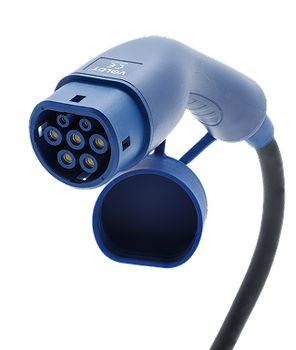
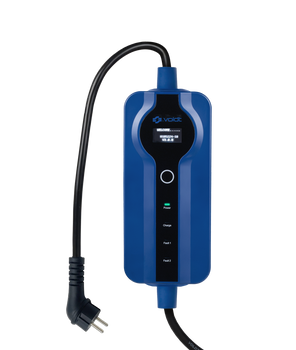
The Voldt® Type 2 to CEE 5-pole 16A charging cable is a portable charging solution designed for electric vehicle drivers who need controlled, reliable charging from industrial CEE power connections. It connects a Type 2 vehicle inlet to a 5-pole CEE 16A socket, making it suitable for locations such as workshops, garages, business premises or private installations where CEE power is available. The adjustable current setting allows the charging power to be matched to the electrical installation, reducing unnecessary load while maintaining safe operation.

The cable supports charging capacities of up to 11 kW with 16A current and three-phase operation. Charging current can be set between 8A and 16A, and the cable operates in Mode 2. It is IP67-rated for protection against dust and water, certified according to CE, UKCA and TÜV standards, and designed for more than 10,000 insertion and extraction cycles. An operating temperature range of −30°C to +50°C ensures dependable performance in both indoor and outdoor environments.

Voldt® Portable EV charger commando plug | 3 phase | 8A - 16A | 11kW + APP

Specifications

Charging capacity 11kW
Phases 3 Phases
Amperage 16A
Mode Mode 2
Protection class IP67
Certificates CE, UKCA & TÜV
Insertion/extraction >10.000x
Working temperature -30°C ~ +50°C
Cable weight 300 g/m
Extra feature Delayed charging
Type Charging cable

European charging cables

Designed and manufactured by Voldt® in Europe, this charging cable reflects a focus on durability, safety and long-term usability. High-quality materials, robust connectors and strict quality control are used to ensure consistent performance over years of daily use. European production guarantees compliance with applicable standards and avoids the compromises often found in generic imported charging equipment.

Voldt® supports this charging cable with free same-day shipping on weekdays, a 100-day hassle-free return policy and a 3-year warranty. This combination of certified products and transparent service gives drivers confidence that they are choosing a dependable charging solution from a European manufacturer committed to practical, no-nonsense electric mobility.

Voldt® Portable EV charger commando plug | 3 phase | 8A - 16A | 11kW + APP

Not sure which cable you need?

Voldt® Portable EV charger commando plug | 3 phase | 8A - 16A | 11kW + APP
The plugs we have developed are produced from one whole and therefore not glued or screwed together. This makes the plugs stronger, more wear-resistant and more waterproof than other plugs on the market.
Join 100,000+ EV drivers across Europe, from the Netherlands to Norway, who trust Voldt® to keep them powered every day, everywhere.

Unmatched durability, ultimate protection.

3 year warranty
ISO 9001 certified quality management badge
100 days hassle free return
Free shipping

Voldt®; Powering the Next Century of Driving

With more than 100 years of combined experience in the automotive industry, Voldt® embodies a legacy built on engineering excellence, craftsmanship, and innovation. Our deep heritage gives us a unique understanding of mobility and the evolving needs of electric vehicle drivers. As the world shifts toward cleaner transportation, we apply a century of expertise to create charging solutions that deliver true reliability, long-lasting performance, and a superior user experience.

Voldt® will integrate with your electric vehicle seamlessly.

Yes, a mobile EV charging cable such as the Voldt® mobile charger can be set to delay charging when connected to a CEE power socket or a normal household socket. This feature is particularly useful when you want to start charging during off-peak electricity hours or when energy tariffs are lower. Delayed charging helps reduce costs and eases the load on the power grid, especially in areas with dynamic electricity pricing.

The Voldt® mobile EV charger is equipped with an intuitive delayed charging function. You can easily set it up in a few steps. The delay can be set in 1-hour increments, up to a maximum of 10 hours. Here's how to do it:

How to activate delayed charging on your Voldt® mobile charger:

  • Plug the charger into a power socket (CEE or Schuko).
  • Connect the charging cable to your electric vehicle.
  • Turn on the charger (the display will light up).
  • Press and hold the setting button for 3 seconds to activate a 1-hour delay.
  • For each additional hour of delay, press and hold the setting button again for 3 seconds.
  • Example: Pressing and holding 3 times = 3-hour delay.
  • Once you reach the desired delay time, stop pressing the button.
  • The countdown will begin, and charging will start automatically after the set delay.

This function is available on both household (230V Schuko, approx. 2.3–3.0 kW) and industrial (CEE 16A/32A, up to 22 kW) sockets, depending on the model. While the delayed charging function behaves the same across socket types, the actual charging speed will depend on the power source and your EV’s onboard charger. With Voldt®, you get flexible, efficient, and safe charging tailored to your schedule.

Yes, CEE 16A and CEE 32A sockets differ significantly in power capacity, physical dimensions, applications, and cabling. The most important distinction is the maximum current each can handle: a CEE 16A socket supports up to 16 amps, while a CEE 32A socket is designed for 32 amps. This means a CEE 32A connection can deliver nearly double the electrical power, which is essential for high-demand applications such as industrial machinery or fast charging of electric vehicles.

Physical size and compatibility

One of the most noticeable differences is the physical size of the plug and socket. A CEE 32A socket is substantially larger and sturdier than a 16A socket. The 32A version typically has an outer diameter of around 70 mm compared to approximately 50 mm for the 16A. The pins are also thicker and spaced further apart. These differences are intentional to prevent mismatching: a 32A plug will not fit a 16A socket and vice versa, improving safety for higher-power connections.

Technical capacity and cabling

A CEE 16A socket is usually used for 230V (single-phase) or 400V (three-phase) applications and can deliver up to 11 kW. The CEE 32A socket can deliver up to 22 kW, making it ideal for more power-intensive setups like the Voldt Type 2 mobile charger with CEE 32A plug. This also means thicker cabling is required — typically 6 mm² for 32A vs. 2.5 mm² for 16A — to handle the higher current safely.

Applications and installation

CEE 16A sockets are common in camping grounds, garages, or for lighter mobile uses. CEE 32A sockets are used in industry, food trucks, construction sites, or high-capacity EV chargers. Their larger size means they’re also physically more robust and often waterproof (IP44 or IP67). Proper installation in the UK must include appropriate fuses and RCDs in line with BS 7671 wiring regulations.

The steps between 8A and 16A for a mobile charging cable are: 8A, 10A, 13A, and 16A. These are standard settings on adjustable mobile charging cables, such as those from Voldt®, allowing you to adapt the charging power to the available power supply and location.

Why are these steps selected?

Each step (8A, 10A, 13A, 16A) corresponds to common circuit breaker levels and domestic grid standards across Europe. 8A is the most conservative option and is useful for older installations. 10A is a moderate step that fits most household sockets. 13A is common in the UK, where plugs are fused at 13A. The 16A setting offers the fastest charging rate where a dedicated circuit or heavy-duty socket is available.

Practical use of adjustable current levels

Adjustable charging cables like the Voldt® Type 2 mobile charging cable allow manual or digital selection of current. This is essential when charging at locations with limited power or shared circuits. Lower current avoids tripping breakers, while 16A enables faster charging if the grid can handle it.

Safety and compatibility

Correct current settings are crucial for safe charging. Voldt® charging cables include thermal sensors and overload protection, and they shut off automatically in unsafe conditions. Make sure the selected current matches your electrical system, and check if you're on a 1-phase or 3-phase setup. Some countries have different rules for 16A connections, so always verify local requirements.

The difference between Mode 1, Mode 2, Mode 3, and Mode 4 charging lies in the level of communication and safety between the electric vehicle (EV), the charging cable, and the power source, as well as the type of current used (AC or DC). Each mode represents a different way of delivering electricity to an EV, with increasing levels of control and safety from Mode 1 to Mode 4.

Mode 1 charging is the most basic and outdated form of EV charging. It involves a simple cable that connects an EV directly to a standard household socket (AC), with no built-in communication or safety features. The cable lacks a control box, so there's no way to verify if the vehicle is drawing power safely. As a result, Mode 1 is rarely used for modern EVs due to high risks such as overheating, electric shock, and potential fire hazards. It is also not compliant with many international safety standards, and is banned in several regions.

Mode 2 charging improves on Mode 1 by adding an In-Cable Control and Protection Device (IC-CPD). This allows the charging cable to plug into a standard socket (usually Schuko or BS 1363) while integrating basic safety functions like temperature monitoring and earth leakage protection. The IC-CPD enables limited communication between the cable and the vehicle, typically restricting the current to safe levels (usually up to 10 A or 13 A). This makes Mode 2 a practical solution for occasional or emergency charging at home, but it’s not ideal for regular use due to slower charging speeds and stress on domestic wiring.

Mode 3 charging involves dedicated EV charging stations connected to the AC grid, using a Type 1 or Type 2 connector and enabling full communication between the EV and the charging infrastructure. These stations can deliver higher current levels (typically up to 32 A or even 63 A), resulting in faster charging. Mode 3 setups include advanced safety protocols such as automatic power cut-off, dynamic load management, and secure identification. This is the standard mode for public AC charging points and home wallboxes across Europe, especially using Type 2 connectors in accordance with IEC 61851.

Mode 4 charging is used exclusively for DC fast charging. In this mode, the AC to DC conversion happens within the external charger, not inside the vehicle, allowing for much higher power delivery—typically from 50 kW up to 350 kW. It requires heavy-duty connectors like CCS (Combined Charging System) or CHAdeMO and involves constant, high-level communication between the vehicle and the charger for current regulation, battery monitoring, and thermal management. Mode 4 is ideal for quick top-ups on motorways or commercial fleets and is governed by standards like IEC 61851-23 and IEC 62196-3.

In summary, Modes 1 and 2 are for basic or household charging (AC), Mode 3 is the most common AC charging method with integrated safety and communication, and Mode 4 is used for rapid DC charging with full system integration and high power delivery.

A portable EV charger is a flexible charging device that allows you to charge your electric vehicle anywhere with access to power. It connects directly to a household socket or industrial outlet, eliminating the need for a fixed wallbox. Compact and easy to transport, it delivers the same safety and reliability as a stationary unit while giving you the freedom to charge at home, at work, or while travelling. Voldt’s range of portable EV chargers is compatible with both Type 1 and Type 2 connectors and includes adjustable amperage control for optimal charging speed.

A portable EV charger works by safely converting AC power from the grid into a controlled current for your vehicle’s battery. The internal control box manages power flow, monitors temperature, and prevents overcurrent or short circuits. Simply plug one end into a power source and the other into your EV’s charging port. With amperage settings from 8A to 32A and output options from 2.8 kW to 22 kW, Voldt® chargers ensure secure, efficient charging on single-phase or three-phase connections.

If you place your order before 15:00 on a working day, it will be shipped the same day. Voldt® offers free same-day shipping as part of our commitment to fast and reliable service. Delivery usually takes between 1 and 2 business days, depending on your location and the courier’s schedule. All orders are dispatched directly from our European warehouse and include full tracking, so you can follow your package from dispatch to delivery with complete peace of mind.

Once you have placed your order and made your payment, you will automatically receive an email with information about the tracking number of your parcel.

Contact us for more information

For questions or general inquiries, please leave your contact information below and we will get back to you as soon as possible.

Thank you for submitting your form!

We appreciate your interest and will review your information as soon as possible.

Our team is dedicated to providing excellent customer service, and we will do our best to respond promptly.