



Every new EV driver hits the same question sooner or later: do I need to buy a cable for those big rapid chargers at motorway services? The short answer is no, you never do. But understanding why not, and knowing what you do need to buy, will save you money, confusion, and at least one awkward moment in a car park.
| Key Insight | What it means for you |
| DC rapid chargers always have a fixed cable | You never need to bring or buy a cable for CCS2 or CHAdeMO charging |
| CCS2 is the universal standard for new EVs in the UK | Every new car sold today uses CCS2 for rapid/ultra-rapid charging |
| CHAdeMO is declining, but not gone | Thousands of Nissan Leaf and Mitsubishi drivers still rely on it daily |
| Your own cable matters for AC charging | Hotels, car parks, workplaces, and National Trust sites typically have a socket, not a tethered cable |
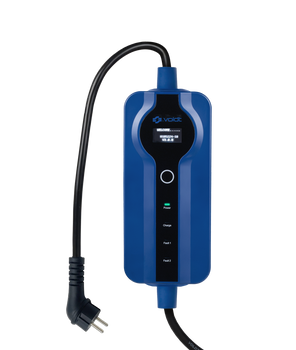
| A portable 3-pin charger is your universal backup | Every domestic socket in the country becomes a charging point |
Why rapid chargers have a fixed cable (and why you can't buy one)
If you've pulled into a Gridserve Electric Highway forecourt or a BP Pulse hub at a motorway services, you'll have noticed the cables are permanently attached to the charger. That's not a design choice, it's an engineering requirement. DC rapid and ultra-rapid chargers push between 50 kW and 350 kW directly into your battery, bypassing the car's onboard charger entirely. At those power levels, the cables need to be liquid-cooled, heavily insulated, and precisely matched to the charger's power electronics. The connector at the end (CCS2 on modern chargers, CHAdeMO on older units) is built into the cable assembly as a single engineered unit. You can't buy one separately any more than you'd buy your own fuel hose for a petrol station.
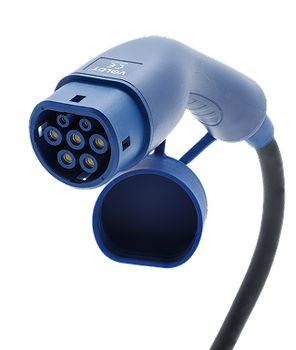
The CCS2 connector itself is worth understanding, because it explains why the charging landscape is simpler than it looks. CCS2 combines a standard Type 2 AC plug (the seven-pin connector you use at home or at a destination charger) with two additional DC power pins at the bottom. One connector, two functions. That's why your car only has one charging inlet: the top half handles AC charging from your wallbox or a public post, and the full CCS2 connector handles DC rapid charging. Older CHAdeMO cars, like the Nissan Leaf, need two separate ports because CHAdeMO is DC-only: one for AC (Type 2), one for DC (CHAdeMO). The practical takeaway: you never buy, carry, or worry about a cable for rapid or ultra-rapid charging. You drive up, grab the charger's own cable, plug in, and wait. The cable you need to think about is the one for the other 80-90% of your charging, which happens on AC.
CCS2 vs CHAdeMO: where things stand in the UK
CCS2 is the standard. Every new EV sold in the UK uses it. Every new rapid and ultra-rapid charger installation, whether it's BP Pulse, Gridserve, InstaVolt, Osprey, or the Tesla Supercharger network (now open to non-Tesla vehicles), is CCS2. If you're buying a new EV today, CCS2 is your only concern, and the network is large and growing.
CHAdeMO is a different conversation, and the UK has one of the largest CHAdeMO-dependent fleets in Europe. The Nissan Leaf has been one of the UK's most popular EVs for over a decade. Over 270,000 units were produced at the Sunderland plant before production ended in March 2024, and a large proportion of those are still on UK roads. Every single one uses CHAdeMO for DC rapid charging. Add the Mitsubishi Outlander PHEV and the older Peugeot iOn and Citroën C-Zero (both rebadged Mitsubishi i-MiEVs), and you have a significant fleet of CHAdeMO-dependent vehicles.
The infrastructure is still there, for now. BP Pulse maintains dual CCS/CHAdeMO units at many locations. Gridserve offers CHAdeMO support alongside CCS at several Electric Highway sites. But the trajectory is unmistakable: no new charger installations include CHAdeMO connectors, and as older units are replaced, the CHAdeMO option disappears with them. For Leaf drivers, this creates a growing practical problem. Fewer CHAdeMO chargers each year, concentrated at older stations, with no new ones being added. Your rapid charging options are contracting, not expanding. Zap-Map is essential for checking connector availability before you set off, because the charger that had CHAdeMO six months ago might not have it today.
This is where a CCS2-to-CHAdeMO adapter changes the equation. The Voldt® CCS2-to-CHAdeMO adapter (CE & UKCA certified, IP67-rated, operating temperature from -30 °C to +85 °C) plugs onto the cable at any CCS2 rapid charger and converts it for your CHAdeMO car. Instead of filtering Zap-Map for the shrinking list of CHAdeMO-equipped stations, you gain access to most of the CCS2 network: BP Pulse, InstaVolt, Osprey, Gridserve, Ionity. Your car's native charging speed stays the same (around 43-50 kW for a Leaf), but you gain enormous flexibility on where you can stop. The adapter is an active device with an internal battery that translates between the CCS2 and CHAdeMO communication protocols, so give it a quick USB-C charge if it's been sitting in the boot for a while before a long trip. At ultra-rapid stations where the liquid-cooled cables are heavy, make sure the cable rests supported so it doesn't hang its full weight from the adapter and strain your car's charging port. For anyone who plans to keep driving their Leaf for another few years (and given how reliable they are, that's most owners), the adapter is the difference between watching your rapid charging map shrink and having it expand.
What you actually need to buy
Three tiers, from essential to optional.
1. A Type 2 charging cable: the one cable every EV driver needs
This is the cable you use at public AC chargers: hotel car parks, workplace chargers, shopping centres, National Trust properties, council-run lamp post chargers. Most of these have an untethered Type 2 socket, which means you need to bring your own cable to connect your car to the charger. At home, most wallboxes come with a tethered cable, so your own Type 2 cable lives in the boot for public use. Length matters more than you'd expect: charging bays vary in layout, and a cable that's too short means you can't reach the socket from certain parking positions. 6 metres is the practical minimum for flexibility. If you regularly park further from the post, or want to be safe in any configuration, 8 metres or longer gives you full coverage. Voldt® Type 2 cables are CE/UKCA/TÜV certified and IP67-rated, so they handle rain, puddles, and a British winter without issue. They come with a 3-year warranty, 100-day hassle-free returns, and free shipping.
2. A portable 3-pin charger: your universal backup
Every house, holiday cottage, and older building in the UK has 13A sockets. A portable 3-pin (Type G) charger lets you charge from any of them: 2.8 kW, adding roughly 10-15 miles of range per hour. It won't rival your wallbox, but it means you can charge at your parents' house, at a B&B, at a campsite, or anywhere else with a standard domestic socket. This isn't a daily charging solution, it's the thing in your boot that means you're never truly stuck.
3. What you don't need
You don't need a CCS2 cable or a CHAdeMO cable: these don't exist as consumer products, because the cable is always part of the charger. And you don't need to panic about connector types. If you drive a modern CCS2 car, every new rapid charger in the UK works with your car. If you drive a Leaf or another CHAdeMO vehicle, the CCS2-to-CHAdeMO adapter solves the compatibility gap and future-proofs your charging access.
The 80/20 rule of EV charging
Most new EV drivers focus on rapid charging, because it's the closest thing to the petrol station experience they know. But 80-90% of real-world charging happens at home, at work, or at a destination: all on AC, all on a Type 2 connection, all at 7 kW (from a typical UK single-phase home wallbox) or up to 22 kW at some public AC posts. Rapid chargers handle the long trips: the motorway run to see family, the drive to the coast, the work trip to the other end of the country. For those, you pull up, use the charger's built-in CCS2 cable, and carry on. Everything else, the daily commute, the weekly shop, the overnight top-up, happens on your own cable, from your own wallbox or a public AC socket.
A good Type 2 cable and a portable 3-pin charger in the boot cover the full range of real-world charging scenarios. That's the gear that actually matters for day-to-day EV life. The rapid charger handles the occasional sprint. Your cable handles the marathon.