



You're 200 miles from home, the satnav says the next charger is 40 minutes away, and the app you downloaded last week wants you to verify your email before you can start charging. EV road trips have come a long way, but they still reward drivers who plan ahead. This checklist covers everything you need before you set off: cables, apps, payment methods, adapters, and the practical things most drivers only learn the hard way.
Key points
| Question | Short answer |
|---|---|
| Which apps do I actually need? | One route planner (ABRP), one charger finder (PlugShare), and one roaming payment app (Shell Recharge, Chargemap, or Octopus Electroverse). |
| What cables should I bring? | A Type 2 cable for AC charging (most public chargers in Europe), and a portable EVSE as backup for emergencies. |
| Do I need an RFID card? | Useful as backup when mobile signal fails. Most roaming apps offer one for around £5 to £20. |
| What about contactless payment? | EU rules mandate contactless on new fast chargers, but coverage is uneven. Don't rely on it as your only payment method. |
| How much battery should I arrive with? | Plan to arrive at chargers with 10 to 20% remaining. Charge to 80%, not 100%, to save time on road trips. |
| Do I need adapters abroad? | Type 2 is standard across Europe, no adapter needed. CCS Combo 2 is the DC standard. Older CHAdeMO cars may struggle. |
Before you leave: the planning phase
The best EV road trip starts before you set off. Most charging frustration on the road comes from things that could have been sorted in 20 minutes at the kitchen table. Get the planning right and the driving part takes care of itself.
Three apps form the core of any European EV trip in 2026. They each do a different job and you really do need all three:
- A Better Route Planner (ABRP): the route planner. You enter your car model, current charge, destination, and arrival battery target, and ABRP gives you a stop-by-stop plan. Free version covers most needs, premium (around £5/month) adds live state of charge and auto-rerouting.
- PlugShare: the charger finder. Community-driven, with photos, reviews, and live check-ins from other drivers. Use it to verify a charger is actually working before you commit to driving there.
- One roaming payment app: more on this below. Pick one and stick to it.
You can replace ABRP with your car's native planner if it's good (Tesla, Polestar, and most Hyundai/Kia models do well here), but ABRP is still worth keeping installed for cross-checking. Apple Maps and Google Maps now plan EV routes too, but live charger status is patchy outside major motorways.
What to pack
This is where most drivers pack too little. Here's what should actually be in the boot:
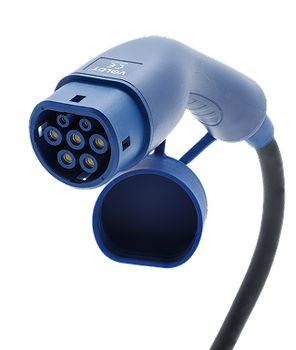
- A 6-metre Type 2 to Type 2 cable: the workhorse. AC public chargers in Europe almost universally require you to bring your own cable. 6 metres is the practical minimum, anything shorter forces you to park awkwardly close to the post. Make sure it matches your car's amperage (typically 16A or 32A).
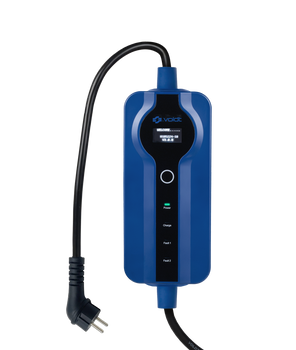
- A portable EVSE ("granny charger"): this lets you plug into a regular household socket if you can't reach a charger. It's slow (around 10 km of range per hour) but it gets you home or to the next station. Some come with adapters for industrial CEE sockets, which are common at campsites and farms across Europe.
- A V2L adapter (optional): if your car supports Vehicle-to-Load, an adapter lets you run small appliances off the battery. Useful for camping or roadside emergencies, not essential for charging.
You don't need a CCS or CHAdeMO cable. DC fast chargers come with their cables attached, you just plug in.
Payment methods: pick your roaming setup
This is the part most road trip articles skip over, and it's the part that causes the most stress at 11pm at a motorway services in Belgium. Here's how it works in practice.
Europe's charging networks are still fragmented. Each country has dominant networks (Allego in NL, Ionity on motorways, Fastned at hubs, EnBW in Germany, BP Pulse in the UK), and each network has its own app and pricing. You can't realistically install ten apps and expect to keep track. Instead, the standard setup is:
- One roaming app as your default: this works at most networks across Europe with a single account. The three reliable choices in 2026 are Shell Recharge (widest coverage, no monthly fee), Chargemap (strong on community data, especially in France and Southern Europe), and Octopus Electroverse (best for UK drivers, with discounted rates at many networks).
- One RFID card for backup: every roaming provider above ships a physical card on request. Costs £5 to £20 once-off and works even when mobile signal fails. Worth it.
- One backup payment card: contactless payment is now mandatory on new fast chargers in the EU under AFIR rules, but rollout is uneven. A normal credit or debit card with contactless will save you at maybe 60% of recent fast chargers if your app fails.
One trade-off worth knowing: roaming apps add roughly 5 to 15 cents per kWh on top of the network's own price. For occasional use, that's worth paying for the convenience. If you're charging a lot at one network during your trip, downloading that network's own app for the week can save real money.
Adapters: what you actually need
For most modern EVs travelling within Europe, the answer is: nothing. Type 2 is the universal AC standard, CCS Combo 2 is the universal DC standard. You can drive from Lisbon to Helsinki without a single adapter.
The exceptions:
- Older CHAdeMO cars (early Nissan Leaf, Mitsubishi Outlander PHEV): the network is shrinking. Plan ahead, CHAdeMO chargers are now rare in some countries.
- Tesla drivers using Superchargers: V3 and V4 Superchargers in Europe use CCS Combo 2 connectors directly, so no adapter needed. Older V2 sites may still have proprietary connectors at some locations.
- UK to mainland travel: no adapter needed for charging. The connectors are identical. You will however need a UK-to-EU plug adapter if you bring a portable EVSE that uses a UK three-pin plug.
- Campsite or farmhouse charging: a CEE 16A "blue" or 32A "red" industrial adapter for your portable EVSE is genuinely useful if you're staying somewhere rural without a proper EV charger.
The practical checklist: 24 hours before you leave
Print this, screenshot it, or just run through it the night before:
- Charge to 100% before departure (the only time it's worth charging fully, since you'll use it immediately).
- Plan your route in ABRP and screenshot the charging stops, just in case mobile data fails.
- Verify each app you'll use has a working payment method and is logged in.
- Check that your roaming RFID card is in the car, not on the kitchen counter.
- Top up the windscreen wash, check tyre pressures (low pressures cost real range, especially at motorway speeds).
- Pack the Type 2 cable and portable EVSE if you have one.
- Set your car's preconditioning if you have it, the battery warms up faster and DC charging is significantly quicker on a warm pack.
- Download offline maps for your route in Google Maps or Apple Maps as a backup, mobile coverage drops in rural areas of Spain, Portugal, and Norway in particular.
On the road: small habits that save real time
Once you're driving, a few habits make a measurable difference:
- Charge to 80%, not 100%. The last 20% takes as long as the first 60%. On a road trip, leaving at 80% with one extra stop saves time overall.
- Arrive at chargers with 10 to 20% remaining. Lower state of charge means faster charging speeds. Arriving at 50% wastes the high-speed charging window.
- Precondition before fast charging if your car supports it. Tells the battery you're about to fast-charge, so it warms up. Most modern EVs do this automatically when you set a fast charger as a destination. In winter, expect noticeably slower DC charging speeds until the battery warms up, especially below 5°C.
- Charge during meal stops, not short breaks. A 25-minute charge from 15% to 80% lines up neatly with a coffee and sandwich. Trying to do quick top-ups at fast chargers usually wastes time.
- Check PlugShare for any charger you're committing to. A two-second glance at recent driver check-ins tells you whether the charger is broken, in use, or fine.
Make your EV road trip simpler with Voldt®
The biggest difference between a smooth EV holiday and a stressful one usually comes down to two things: the right cable, and a payment plan that works across borders. The first part is what we do.
Voldt® supplies drivers across Europe with Type 2 charging cables, portable chargers, and accessories built to do exactly what they should: CE, UKCA and TÜV certified, IP-rated for outdoor use, with a 3-year warranty, 100-day hassle-free returns, free shipping, and always in stock. Premium quality, straight from the European manufacturer. Explore the full Voldt® Type 2 charging cable range and find everything your road trip needs.