




Published 28/09/2026 · Updated 28/09/2026 · By Voldt® product team
In the UK and seven other countries in this overview, an employer can repay home charging of a company car without a benefit in kind for the driver, as long as the electricity can be shown to have gone into the car. Spain, Italy and Sweden tax the repayment in some form, and Portugal handles it as a company expense against the driver's debit note. What differs is the proof: some tax offices want a separate meter, others accept a per-session record.
Key points
8
No extra tax for the driver
UK, Germany, the Netherlands, France, Denmark, Norway, Poland, Finland.
3
Taxed in some form
Spain, Italy, Sweden (private driving).
2
A separate meter is a written condition in Germany and Finland.
01 · The overview
Which countries tax the repayment of home charging?
Spain, Italy and Sweden. In the other nine, the repayment adds no tax for the driver when the amount matches the car's real use.
Where private use of the car is taxed as a flat benefit, the electricity usually sits inside that benefit. Where the tax office treats fuel as a separate benefit, the electricity follows the same route.
Fig. 1
Tax on repaid home charging, by country

8 · No extra tax for the driver
United Kingdom, Germany, Netherlands, France, Denmark, Norway, Poland, Finland
3 · Taxed in some form
Spain, Italy, Sweden
1 · Company expense
Portugal
National rules as cited in each Voldt® market article, September 2026.
United Kingdom
Tax on the repayment
None (ITEPA 2003, s. 239)
Condition
Proof the electricity went into the company car
Germany
Tax on the repayment
None
Condition
Separate meter; own tariff or flat electricity rate
Netherlands
Tax on the repayment
None
Condition
Repayment per measured kWh
France
Tax on the repayment
None, electricity stays outside the benefit in kind
Condition
Real cost repaid
Denmark
Tax on the repayment
None for drivers taxed on a free car
Condition
Documented cost per car
Norway
Tax on the repayment
None, covered by the standard supplement
Condition
Electricity linked to the company car
Poland
Tax on the repayment
None, within the 250 zł flat allowance
Condition
Amount matches documented costs
Finland
Tax on the repayment
None with a free car benefit
Condition
Separate measuring device
Portugal
Tax on the repayment
Company expense
Condition
Driver's debit note based on demonstrable kWh
Spain
Tax on the repayment
Taxed as a separate benefit in kind
Condition
Valued on the car's kWh
Italy
Tax on the repayment
Taxed as employment income
Condition
Repaid energy counts as income
Sweden
Tax on the repayment
Private: fuel benefit; business trips: 9,50 kr per mil tax-free
Condition
kWh and mil must be shown
Read the full rules for each country
02 · Proof
What proof does each tax office accept?
A reading of the kWh that went into the car. A household meter reading alone is weak proof, because it mixes the car with the rest of the home.
HMRC asks only for proof that the electricity went into the company car, and a per-session log provides it directly. Germany and Finland go further and write the separate meter into the rule. Denmark's tax council rejected a model that estimated the car's share of the household bill, and Polish rulings accept meter readings or charger reports.
Voldt® tip
Ask your payroll provider which record they import. Most fleet platforms take the session export from a charger directly, so the proof and the monthly repayment come from the same file.
03 · Price
Who sets the price per kWh?
In most countries, the driver's own tariff. The UK and Germany also offer a fixed rate.
HMRC's advisory electricity rate for home charging is 7p per business mile (rates from 1 September 2026), and needs no meter reading. Public charging has its own, higher rate. It covers business miles only, and commuting counts as private travel. For private use, the actual cost per kWh applies, which is why the kWh count matters.
Voldt® tip
Put the pricing method in the car policy when the car is handed over, and update the tariff once a year.
04 · Changes
Which rules are changing?
The UK, the Netherlands and Germany have the nearest dates.
Fig. 2
Dated rule changes, 2026 to 2031
2026
DE
Jan
DK
Jan
SE
Jul
2027
NL
Jan
2028
UK
Apr
2029
Nothing scheduled
2030
Nothing scheduled
2031
NL
Jan
Belastingplan 2026 · Overige fiscale maatregelen 2027 · BMF, 11/2025 · HM Treasury · Skatteverket · Skattestyrelsen.
- UK: company car tax on plug-in hybrids moves to a flat 18% in April 2028.
- Netherlands: from 1 January 2027, a 12% employer levy on petrol, diesel and hybrid company cars with private use; fully electric cars are exempt.
- Germany: monthly flat allowances for home charging ended on 1 January 2026.
- Sweden: workplace charging is permanently tax-free from 1 July 2026; home charging is not included.
- Denmark: the electricity tax is at the EU minimum for all consumption in 2026 and 2027.
05 · The record
How do you get a kWh record per session?
With a charger that logs each session against the driver who plugged in.
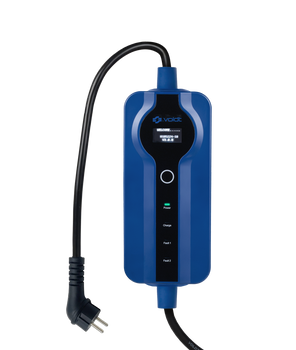
The Voldt® 3-pin portable charger does that from a standard 3-pin socket. Its control box measures the kWh of every session, and the Voldt® app keeps the session history per user, with the date and time, ready to export as a monthly log for the claim. No chargepoint has to be installed, so it also works for drivers who rent, share a car or move house. The options are shown below.
Our verdict
Repay home charging from the kWh logged per session, linked to the driver. With a portable 3-pin charger that logs each session in its app, your staff charge at home at their own electricity tariff instead of at a public chargepoint, without a chargepoint installed at every home.
Buy it if
your staff charge at work and have no chargepoint at home, so they now charge at public chargepoints.
Skip it if
your staff only charge at work, or already have a home chargepoint that records every session per driver.
Voldt® 3-pin portable charger

Voldt® 3-pin portable charger with app
Current
8 to 13 A
Power
up to 2,8 kW
Plugs
3-pin to Type 2
Session log
kWh per charge, per user
Lengths
5, 10, 15 or 20 m
CE, UKCA and TÜV certified · IP67 · 3-year warranty · 100-day returns
Safe use and warranty
- Plug the charger straight into a sound, earthed 3-pin socket, never an extension lead or adaptor.
- Use the 13 A setting only on a socket on its own circuit that an electrician has checked.
- Where your car's manual differs from this guide, follow the manual.
Voldt® cables and portable chargers are CE and UKCA marked and TÜV certified, with a 3-year warranty; terms and exclusions are on the warranty and complaints page.
CE · UKCA · TÜV · IP67 · 3-year warranty · 100-day returns
FAQ
Is repaid home charging always tax-free?
In the UK, yes, under section 239 when you can prove the electricity went into the company car. Abroad, it is tax-free for the driver in seven more of the 12 countries.
Does a household meter reading count as proof?
Not on its own. It shows the whole home.
Can we use the advisory electricity rate instead?
For business miles, yes. It does not cover commuting or other private driving.
Does public charging follow the same rules?
No. Public charging on a fuel card is treated separately.
Which price per kWh should we use?
The driver's actual tariff for the period, updated when the tariff changes.
Where are the full rules per country?
Each country has its own Voldt® article, linked below the table.
Voldt® product team, product development and support
Develops Voldt® charging cables and portable chargers and answers the questions that reach Voldt® support.