



Key points
| 01 | What is a mobile Type 2 charger? A portable charging cable with built-in control, suitable for use with Type 2 sockets or via suitable adapters. |
| 02 | Is a portable EV charger safe? Yes, if it is certified and connected to a grounded circuit. |
| 03 | When do you choose a mobile charger instead of a wallbox? For rental properties, a second car, travel, or as a temporary solution. |
| 04 | How much does a mobile Type 2 charger cost? Between £130 and £350, depending on charging power and brand. |
| 05 | How much does a wallbox cost including installation? On average between £700 and £1,300. |
| 06 | Is wallbox vs mobile charger always an either-or choice? No, many drivers use both at the same time. |
Mobile Type 2 charger or fixed wallbox: what suits you best?
Should you install a wallbox, or is a mobile EV charger the smarter choice? More and more EV drivers are choosing flexibility. The best choice depends on your living situation, driving habits, and budget. In this article, we compare both options so you can quickly see what suits you best.
What is a mobile Type 2 charger?
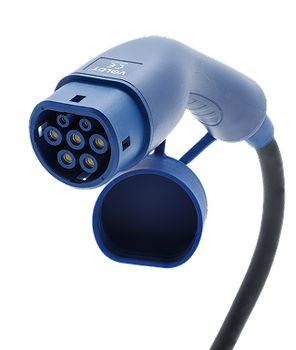
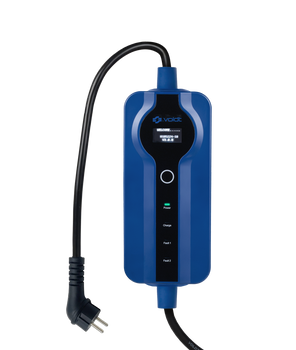
A mobile Type 2 charger is a portable charger that you connect to Type 2 connections or via suitable adapters, without requiring a fixed installation. The charger has a built-in ICCB unit that manages communication between the car and the power grid, just like a wallbox, but without permanent mounting. This makes it suitable for virtually all charging situations, both at home and on the road.
Most mobile chargers charge with a power output from 3.6 kW (single-phase, 16A) up to 7.4 kW (single-phase, 32A). Some models automatically adjust to the available power from the socket, making them especially easy to use. For PHEV drivers, this output is more than sufficient in most cases to fully charge the battery overnight. Voldt® offers mobile chargers with a power output from 2.8 kW up to 22 kW, covering virtually all charging needs.

Wallbox vs mobile charger: the comparison
Choosing between a wallbox and a mobile Type 2 charger is not only about charging speed. Installation costs, flexibility, and living situation play at least as important a role. The table below gives a complete overview of the key differences, so you can quickly see what best fits your situation.
| Feature | Wallbox | Mobile Type 2 charger |
|---|---|---|
| Installation required | Yes, by a certified electrician | No |
| Charging power | 7.4 to 22 kW | 3.6 to 7.4 kW (Voldt®: 2.8 to 22 kW) |
| Suitable for rental property | No (or limited) | Yes |
| Take it with you when travelling | No | Yes |
| Hardware price | £250 to £700 | £130 to £350 |
| Installation costs | £350 to £600 | None |
| Smart functions | Often built in | Sometimes, depending on the model |
| Suitable as a fixed home charger | Yes, optimal | Yes, but less efficient |
When should you choose a portable EV charger?
There are situations where a mobile Type 2 charger is not only practical, but simply the only realistic solution. Below, the most common use cases are explained, including why a portable EV charger is the best choice in these cases.
Rental property
In a rental property, a fixed wallbox is not always an option. Permission from the landlord is required, and the installation cannot be taken with you when you move out. In addition, the costs for a certified electrician and any upgrades to the electrical panel are often the tenant’s responsibility. A portable EV charger works with any grounded socket or an existing charging station nearby, requires no permanent changes, and can easily be taken with you when you move.
Second car
Do you have a household with two electric cars, but only one wallbox? A mobile Type 2 charger as a supplement is much cheaper than installing another fixed solution. You can charge the second car via a socket in the garage or a nearby charging station without extra installation costs or complicated planning. For many families, this is the most practical and cost-effective solution.
Holidays and travel
Across Europe, Type 2 connections at campsites, hotels, and holiday homes are becoming increasingly common. With a mobile Type 2 charger in the boot, you can charge wherever there is power, without depending on fast chargers or specific charging networks. This gives you much greater freedom when travelling, especially in countries where public charging infrastructure is still developing.
Temporary situation
Are you moving soon, waiting for a wallbox installation, or temporarily driving an electric car? Then a portable EV charger is the most flexible solution during the transition period. You immediately get a working charging solution without long planning or fixed costs, and when your situation changes, the mobile charger can easily adapt.

Costs and benefits at a glance
A wallbox requires a larger upfront investment, but charges faster and typically has more smart functions such as scheduled charging and energy management. With daily use and your own home, the investment can pay for itself over time, especially if you make use of subsidies or feed-in to the grid. The total cost of ownership is lower in the long term than frequent use of public charging stations.
A mobile Type 2 charger is cheaper, ready to use immediately, and easy to take with you. The lower charging power is rarely a problem for PHEV drivers or those with short daily drives. For those who value flexibility more than maximum charging speed, a portable EV charger is the obvious choice. You also do not need to hire an electrician, and you are not dependent on a specific home or parking space.
Voldt® offers certified mobile chargers, tailored to a wide range of charging situations.