



You're 30 miles from home, the navigation says the nearest charger is 40 minutes away, and the app you downloaded last week wants you to confirm your email address before it lets you start a session. Long-distance EV driving has never been easier than it is today, but it still rewards the drivers who prepare. This guide covers everything you need before you leave: cables, apps, payment methods, adaptors, and the practical details most people learn the hard way.
Key Takeaways
| Question | Short answer |
|---|---|
| Do I always need to bring a cable? | Not at rapid DC chargers (50 kW+), which are almost always tethered. At standard AC chargers, yes: bring your Type 2 cable. |
| What cable type do I need? | A Type 2 cable (also called a Mennekes cable): the standard for AC public charging across all of Europe. |
| What length should I choose? | 6 metres covers most public charging situations. 8 metres if you park at chargers with the socket at the front or rear of the bay. 4 metres is sufficient for a fixed home wallbox. |
| Does my EV come with a Type 2 cable? | Not always. Some manufacturers include one; others provide only a Mode 2 granny charger or nothing beyond a basic emergency cable. |
| What should I look for in a cable? | IP-rated for outdoor use, rated for your car's maximum AC charging speed (7.4 kW, 11 kW, or 22 kW), and CE, UKCA, and TÜV certified. |
| Do I need adaptors for Europe? | Type 2 is the standard across Europe: no adaptor needed for AC charging. CCS Combo 2 covers DC fast charging. Older CHAdeMO vehicles have fewer options. |
Two Types of Public Chargers: Tethered vs. Untethered
Public charging stations come in two fundamentally different configurations.
Tethered chargers have a cable permanently attached to the unit, much like a petrol pump. You simply plug the connector directly into your car. No cable needed on your part.
Untethered chargers (also called "socket-only" chargers) have one or more sockets but no cable. You connect using your own Type 2 cable: one end into the charger, the other into your car.
Both types are completely normal and widespread across Europe. Knowing which one you're looking at takes about two seconds once you know what to look for.
When You Don't Need Your Own Cable
At rapid DC chargers (typically 50 kW and above), the cable is almost always tethered. These are the large, freestanding units you find at motorway service areas and dedicated fast-charging hubs. The connectors, usually CCS or CHAdeMO, are thick and heavy, which is one reason they stay permanently attached to the charger. With these, you simply walk up, plug in, and charge. No cable required.
Some AC chargers in car parks and retail locations are also tethered, particularly in the UK and Scandinavia. In these cases, the cable is usually a Type 2 connector, and again, you just plug straight into your car.
When You Do Need Your Own Cable
Untethered AC chargers are the standard across most of continental Europe, particularly in the Netherlands, Germany, Belgium, France, and beyond. These chargers deliver AC power through a Type 2 socket, and the expectation is that EV drivers carry their own cable.
This applies to a wide range of locations: on-street chargers, car park columns, destination chargers at hotels or supermarkets, and workplace charging points. If you arrive without a cable, you simply cannot charge.
The logic behind this design is practical: untethered chargers are more compact, the sockets are less prone to vandalism and wear, and drivers with different cable lengths can choose what suits their car's charge port position.
What Is a Type 2 Cable, Exactly?
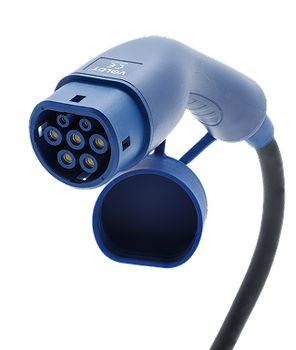
A Type 2 cable (also called a Mennekes cable, after the German manufacturer that designed the connector) is the standard EV charging cable across Europe. It connects your car to AC charging infrastructure, whether at home, at work, or at a public untethered charger.
Both ends of the cable have the same seven-pin connector shape, so it works in both the charger socket and your car's inlet. Type 2 charging cables come in different power ratings, typically 3.7 kW, 7.4 kW, 11 kW, or 22 kW, and in different lengths. We stock cables in 4, 6, 8, 10, and 15 metres to cover every home, workplace, and public charging situation.
The right cable for you depends on your car's onboard AC charging capacity. Most EVs today support at least 7.4 kW (single-phase), and many support 11 kW or 22 kW (three-phase). Your car's manual or specification sheet will confirm this. You can also check our compatibility pages by car model to find the right cable for your vehicle.
Does Every EV Come With a Type 2 Cable?
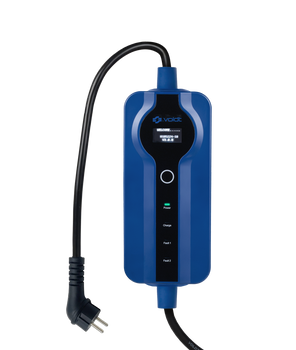
Not always, and this surprises a lot of new EV owners. Some manufacturers include a Type 2 cable in the box; others provide only a domestic plug cable (called a Mode 2 or "granny charger") for slow home charging, or nothing at all beyond a basic emergency cable.
It's worth checking what came with your car, because if you're planning to use public untethered chargers (and most regular EV users will), having a dedicated Type 2 cable is essential. A Mode 2 granny cable will not work in a public Type 2 socket.
How Long Should Your Cable Be?
This comes down to where your car's charge port is located and how chargers are typically positioned. A 6-metre cable is the most versatile choice for everyday public charging: long enough to reach the charger in most parking configurations, without excess cable to trip over, and compact enough to fit neatly in your boot.
If you regularly park at chargers where the socket is at the front or rear of the bay rather than the side, an 8-metre cable gives you more flexibility. For home use on a private wallbox, where the distance is fixed and predictable, a shorter 4-metre cable is often sufficient. For larger vehicles or longer driveways, 10- and 15-metre cables remove any uncertainty about reach.
A Practical Rule of Thumb
Here's a simple way to remember it:
- Fast charger (DC, 50 kW+) at a motorway or hub: cable is attached, nothing to bring.
- Standard AC charger (7–22 kW) in a town, car park, or street: bring your Type 2 cable.
- Home wallbox or workplace charger: depends on whether it's tethered, but having your own cable covers both cases.
When in doubt, carry the cable. It weighs less than a litre of water and fits easily in the boot. Running into an untethered charger without one is a frustrating experience that's entirely avoidable.
What to Look for in a Type 2 Cable
Not all Type 2 cables are made equal. For everyday public and home charging, look for a cable that is:
- Rated for your car's maximum AC charging speed (7.4 kW, 11 kW, or 22 kW)
- IP-rated for outdoor use, meaning it handles rain and damp conditions without issue
- CE, UKCA, and TÜV certified, confirming it meets European and UK safety and performance standards
- Made with quality connectors that lock securely and don't loosen over time
A cable you'll use several times a week needs to be robust. The connectors in particular take the most mechanical stress, so build quality here matters more than price alone.
The Bottom Line
Public charging across Europe is straightforward once you understand the tethered versus untethered distinction. Rapid DC chargers almost always have their own cable. Standard AC chargers, which make up the majority of public charging infrastructure on the continent, typically do not.
Owning a good Type 2 cable means you're ready for both scenarios, at home, at work, and anywhere on the road. It's one of the simplest and most practical investments you can make as an EV driver.
Voldt® manufactures premium Type 2 charging cables built for everyday European conditions: CE, UKCA, and TÜV certified, IP67-rated, backed by a 3-year warranty and 100-day returns. Browse the full Voldt® Type 2 cable range and find the right cable for your car and charging setup.