



You bought an EV to drive, but did you know it can also run your fridge during a blackout, power your tools on a job site, or boil the kettle at a campsite? That's Vehicle-to-Load, or V2L, and it turns your car into a 3.6 kW power station on wheels. In this article we explain how it works, which cars support it, and what you need to actually use it.
Key points
| Question | Short answer |
|---|---|
| What is V2L? | A feature that lets your EV deliver power to external devices, turning the battery into a portable power source. |
| How much power can I get? | Typically 3.3 to 3.6 kW on cars, up to 9.6 kW on EV pickups: more than a standard wall socket (2.3 kW). |
| Which cars have V2L? | Many Hyundai, Kia, Genesis, BYD and newer Ford EVs in 2026, plus selected MG, Polestar and Volvo models. |
| Do I need an adapter? | Yes, for the external charge port. Some cars also have built-in indoor sockets that need no adapter. |
| Will it drain my battery? | V2L stops automatically at a set threshold (usually 15 to 20%) so you always have enough charge to drive. |
| Is it the same as V2H or V2G? | No. V2L powers individual devices. V2H powers your house, V2G feeds the grid. Both need extra hardware. |
What is V2L?
V2L stands for Vehicle-to-Load. It is a feature that lets an electric vehicle deliver power from its battery to external devices, instead of only receiving energy from a charger. Inside the car, an inverter converts the battery's DC output into AC, the same type of electricity that comes out of your wall sockets. For the user, it behaves much like a regular household socket: connect the device, switch on, and you have power.
That covers a lot of ground. A coffee machine at a campsite, a circular saw on a job site without grid access, a fridge during a power cut, a laptop in a car park: all of them work directly off the EV's battery. For most drivers V2L is one of those features that sits unused for months, then becomes the most valuable thing in the car the moment you actually need it.
Which cars have V2L in 2026?
V2L has gone from rare feature to near-standard on new EVs. As of 2026, dozens of EV models now offer V2L functionality, and the list keeps expanding with every new platform launch. Common examples include:
- Hyundai IONIQ 5, IONIQ 6 and IONIQ 9: V2L is standard, with output up to 3.6 kW.
- Kia EV3, EV5, EV6 and EV9: same E-GMP platform as Hyundai, V2L included on most trims.
- Genesis GV60, Electrified GV70 and Electrified G80: V2L via the included external adapter.
- BYD Atto 3, Dolphin, Seal and Sealion 6: V2L on most market versions, output around 3.3 kW.
- MG4 and MG ZS EV: V2L available on selected trims.
- Polestar 3 and Polestar 4: bidirectional charging supporting V2L, V2H and V2V.
- Volvo EX30 and EX90: bidirectional-ready, V2L available depending on market.
- Ford F-150 Lightning and E-Transit: branded as Pro Power Onboard, with output up to 9.6 kW on the Lightning.
- Nissan Leaf (2026): supports V2L and is designed for V2H/V2G compatibility, depending on market and charging standard.
- BMW iX3 (Neue Klasse, 2026): BMW says Neue Klasse models will support bidirectional charging, including V2L and potentially V2H/V2G depending on market rollout.
If you are buying a new EV, it is worth checking the spec sheet carefully. Different brands market the same feature under different names: Ford calls it Pro Power Onboard, others say "onboard power" or simply "AC outlet". Look for the kW output figure and whether the car ships with the V2L adapter included.

What is a V2L adapter?
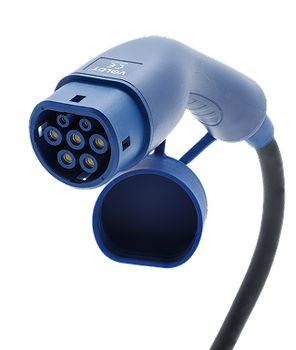
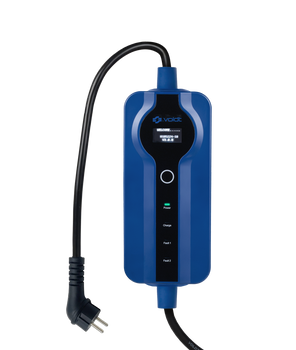
A V2L adapter is a small device that plugs into the EV's charging port and converts it into a standard household socket. Without it, the port can only receive electricity. With it, the same port becomes a power outlet.
Some EVs also have an internal socket built into the boot or under the rear seats. These are convenient for indoor use but limited in placement, and they may offer lower output limits depending on the vehicle. For anything heavier, like running tools outside the car or powering equipment at a distance, the charge-port adapter is what you want.
Compatibility matters. Adapters are tied to specific connector types and output ratings, and using the correct adapter specification is important for compatibility and safe operation. Always confirm that the adapter matches your vehicle's specification before plugging anything in. Voldt® offers V2L adapters built to the same standards as the rest of our range: CE, UKCA and TÜV certified, IP-rated, and backed by our 3-year warranty and 100-day return policy.
How much power does V2L actually deliver?
For most cars, V2L output sits between 3.3 and 3.6 kW. To put that into perspective: a standard European wall socket delivers around 2.3 kW. Your EV, parked anywhere, can therefore power more than a typical living-room outlet. Electric pickups push this further: the Ford F-150 Lightning delivers up to 9.6 kW through Pro Power Onboard, enough to run a small construction site.
In practical terms, 3.6 kW is enough to run a fridge (around 100 to 200 W), charge a laptop (60 W), boil a kettle (2,000 W) and still have headroom for a power tool. You can run multiple appliances at once, as long as the combined load stays under the cap.
Battery drain is the other side of the equation. Running a 1 kW load for 8 hours uses roughly 8 kWh, which is around 10% of a typical 77 kWh EV battery. Most cars with V2L will automatically cut off the function once the battery drops below a preset threshold, usually 15 to 20%, to make sure you can still drive home. If you plan on heavy V2L use, start with a full charge and keep an eye on the consumption.
What is the difference between V2L and a portable power station?
Capacity, mostly an EV holds far more energy than even a large power station.Many portable power stations hold between 1 and 3 kWh, though larger premium units now exceed 5 to 10 kWh. An EV battery holds 60 to 100 kWh, often ten times more. The trade-off is portability: a power station is a small box you can carry, the EV stays where you parked it. For events and emergencies near the car, V2L wins on capacity and cost (no extra device to buy). For activities away from the vehicle, a power station still has its place.
V2L, V2H and V2G: what's the difference?
These three terms get mixed up constantly, and it's worth knowing where one ends and the next begins.
- V2L (Vehicle-to-Load): powers individual devices through a socket or adapter. Simple, no installation needed, works anywhere the car parks. Capped at 3.3 to 9.6 kW depending on the vehicle.
- V2H (Vehicle-to-Home): feeds the EV's battery into your home electrical panel during an outage or peak rates. Requires a bidirectional charger and a transfer switch installed by an electrician. Typically 7 to 11 kW.
- V2G (Vehicle-to-Grid): sends power from the car back to the utility grid. Requires the same bidirectional hardware as V2H plus a contract with a grid operator. Still rolling out across Europe, with BMW, Renault, Volvo and others actively building it into 2026 platforms.
For everyday use cases like camping, tailgating, job sites or a few hours of essential power during a blackout, V2L is all most drivers need. V2H and V2G are interesting if you want full-home backup or want to earn money feeding the grid, but they involve installation cost (€5,000 to €10,000 in 2026) and permitting.

Make the most of your EV with Voldt®
V2L turns your electric vehicle from a depreciating asset into a useful piece of energy infrastructure. Whether you camp, work off-grid, run outdoor events, or just want a backup plan when the lights go out, the battery in your driveway has a lot more to offer than commuting.
Voldt® supports drivers across Europe with charging cables, portable chargers, V2L adapters and accessories, all built to the same standards: CE, UKCA and TÜV certified, IP-rated, free shipping, always in stock, with a 3-year warranty and a 100-day hassle-free return policy. Premium quality, straight from the European manufacturer. Explore the full Voldt® Type 2 charging cable range and find what your EV needs.