Our products are designed, produced and manufactured in Europe.
No energy loss
Our contacts are made of 100% silvered copper (no alloy). This ensures there is no energy loss and thus reduces heat.
Plug in anywhere. Charge everywhere
Safely charge your EV at every charging station across Europe.
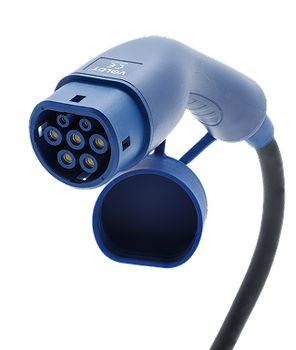
Type 2 | 1 phase | 32A | 7.4kW charging cable
The Voldt® Type 2 | 1 phase | 32A | 7.4kW charging cable is engineered for reliable single-phase charging at home, work, or public stations. As a Type 2 cable, it supports all standard UK and European charging points and delivers up to 7.4kW. The cable features an IP67 protection rating, silver-plated 100 percent copper contacts and a high-flex conductor structure that improves durability and limits heat development. Every component is designed to withstand temperatures from minus 30 to plus 50 degrees Celsius and over 10,000 insertion cycles.
Advanced material selection ensures strong performance and lasting flexibility. The one-piece plug housing is manufactured without screws or glue for improved strength and better protection against water and dirt. The cable weighs 540 grams per metre and uses a large number of fine copper strands, which allows tight bends without internal damage. The result is a robust charging solution that remains easy to handle in daily use while maintaining consistent electrical efficiency.
Specifications
Charging capacity
7,4kW
Phases
1 Phase
Current
32A
Mode
Mode 3
Protection class
IP67
Certificates
CE, UKCA & TÜV
Insertion/extraction
>10.000x
Working temperature
-30°C ~ +50°C
Weight
540g p/m
Type
Charging cable
European charging cables
Voldt® designs and manufactures charging solutions in Europe using high-quality materials chosen for long service life and stable performance. With more than 100 years of experience in the automotive industry, Voldt® focuses on craftsmanship, technical reliability and safe operation in all weather conditions. Each product is certified to CE, UKCA and TÜV standards to ensure trusted performance across the UK and Europe.
Every order includes free same-day shipping on working days, a 100-day trouble-free return period and a 3-year warranty. These service commitments reflect Voldt’s goal of providing dependable charging solutions supported by practical customer care. The combination of European production, strong technical construction and clear service terms makes the Voldt® Type 2 | 1 phase | 32A | 7.4kW cable a dependable choice for everyday charging.
Not sure which cable you need?
The plugs we have developed are produced from one whole and therefore not glued or screwed together. This makes the plugs stronger, more wear-resistant and more waterproof than other plugs on the market.
Join 100,000+ EV drivers across Europe, from the Netherlands to Norway, who trust Voldt® to keep them powered every day, everywhere.
Loading reviews...
Unmatched durability, ultimate protection.
3 year warranty
100 days hassle free return
Free shipping
Voldt®; Powering the Next Century of Driving
With more than 100 years of combined experience in the automotive industry, Voldt® embodies a legacy built on engineering excellence, craftsmanship, and innovation. Our deep heritage gives us a unique understanding of mobility and the evolving needs of electric vehicle drivers. As the world shifts toward cleaner transportation, we apply a century of expertise to create charging solutions that deliver true reliability, long-lasting performance, and a superior user experience.
Voldt® will integrate with your electric vehicle seamlessly.
Do Voldt charging cables lose power due to their length?
No noticeable power loss, even with longer cables
No, Voldt charging cables do not experience any significant power loss due to their length. Voldt uses only high-quality copper conductors with low resistance, ensuring that even longer cables (such as 10 or 15 metres) can efficiently transmit current without noticeable voltage drop. The cables are designed according to international standards (such as IEC 61851 and IEC 62196), which specify maximum allowable voltage drop and heat development, so charging performance remains optimal.
Optimal conductor size prevents voltage drop
In theory, longer charging cables could lead to some power loss, particularly if the cable has a thin conductor or is made from lower-quality materials. Voldt prevents this by using conductors with appropriate cross-sectional area depending on the cable’s maximum current rating (e.g. 6 mm² for 32A 3-phase cables). This keeps voltage drop to negligible levels—typically less than 1%—which is well within regulatory limits. This is crucial for both safety and charging efficiency.
Tested for performance and safety
Finally, all Voldt cables are rigorously tested for electrical performance, temperature rise, and reliability under load. Customers can trust that even a 15-metre cable performs just as well as a shorter one. This makes Voldt cables ideal for situations where the charging point is further away from the vehicle, without compromising on speed or safety.
02.
What is mode 3 charging EV?
Mode 3 charging for an electric vehicle (EV) is a charging method where the EV is charged via a dedicated charging station or wallbox, with controlled and secure communication between the car and the charging point. It is the most commonly used and recommended way to charge at home and at public charging stations.
Key Features of Mode 3 Charging:
Direct connection to a charging station
Safety and Intelligence
Charging Power
Smart Charging
Advantages of Mode 3 Charging:
✔️ Faster charging than a standard household socket (Mode 2).
✔️ Ensures safety with built-in communication and protection mechanisms.
✔️ Efficient energy management with smart charging functionalities.
Comparison with Other Charging Modes:
Mode 1: No communication between the power source and the vehicle (an outdated and not recommended method).
Mode 2: Charging via an electrical socket using a special cable where a computer in the cable handles the communication.
Mode 4: DC fast charging (e.g., CHAdeMO or CCS) where direct current is supplied straight to the battery, often up to 350 kW.
In summary, Mode 3 is the standard and recommended method for daily EV charging, especially at home and public charging points. 🚗⚡
03.
Are Voldt's charging cables suitable for every charging station in the United Kingdom?
Yes, Voldt® EV charging cables are compatible with all standard public and home charging stations in the United Kingdom that support Type 2 connectors. Type 2 (IEC 62196-2) is the official standard for EV charging infrastructure in the UK and across most of Europe, and all Voldt® charging cables are designed to meet this specification. This ensures seamless connectivity whether you’re charging at a public station, a wallbox at home, or a destination charger.
Voldt® offers a wide range of Type 2 charging cables with different amperage and phase options, such as 1-phase 16A, 1-phase 32A, 3-phase 16A, and 3-phase 32A. These variants ensure optimal charging performance depending on your vehicle's onboard charger and the capacity of the charging station. All cables are CE and TÜV certified and manufactured in Europe, ensuring high quality, safety, and full compliance with UK and EU regulations. The cables also feature industry-leading weather resistance, making them reliable for outdoor use in the UK's variable climate.
In addition to standard Type 2 to Type 2 cables, Voldt® also provides mobile charging solutions such as Type 2 to UK 3-pin plug (BS 1363) adapters. These are particularly useful for charging from regular household sockets in the UK. This flexibility ensures that even in locations without a dedicated EV charger, your vehicle can still be charged safely and efficiently. If you're unsure which cable best suits your vehicle or location, Voldt® provides a helpful cable selection tool and expert customer support.
04.
What is the difference between the male and female sides of an EV charging cable plug?
The difference between the male and female sides of an EV charging cable plug lies primarily in their intended connection points and technical design. The male side of the cable, often referred to as the charging station plug, is the end that connects to the EV charging point or wallbox. This side typically has exposed pins that deliver power and communication signals. The female side, commonly called the vehicle connector, is designed to plug into the electric vehicle's charging port and features recessed contacts to enhance safety.
Both sides conform to international standards like IEC 62196-2 (commonly known as Type 2 in Europe), but their configuration and purpose are not interchangeable. The female vehicle connector includes several safety mechanisms such as proximity detection and locking pins, which ensure a secure and tamper-proof connection with the car. In contrast, the male plug lacks these vehicle-specific features but is optimized to fit the infrastructure side of the charging interface.
This male/female distinction is also critical for regulatory and safety reasons. It prevents users from connecting two cables together to create an unauthorized extension, which could lead to overheating, communication errors, or electrical hazards. By ensuring the cable only connects from the station to the car in one direction, the EV charging system maintains proper current flow, grounding, and handshake protocols, which are essential for safe and efficient charging.
05.
In what order do you charge your electric car?
To charge your electric car safely and correctly, follow these steps in the right order: first, make sure your car is parked and switched off.
Then, connect the charging cable to the charging station or wall socket first, and only after that connect it to the vehicle. If you're using a Mode 2 cable (with an in-cable control box for household sockets), make sure the control box is positioned properly before plugging it into the car. The car and charging system will usually communicate automatically, and charging should begin without any extra steps.
To finish charging, always disconnect the cable from the car first, and then unplug it from the charging station or wall socket. This prevents electrical arcing and ensures a safer disconnection. Always monitor the charging status during the session via your car’s display or the charging point’s indicator lights.
06.
Can I use a three-phase EV charging cable in a single-phase charging box?
Yes, you can use a three-phase EV charging cable in a single-phase charging box, but the charging speed will be limited to the capabilities of the single-phase system. The cable will simply use one of the three phases for power transmission, while the other two remain inactive. This setup is electrically safe and commonly supported by both EVs and charging stations, provided that the connectors and standards (typically Type 2 in Europe) are compatible.
From a technical perspective, a three-phase charging cable—such as a Voldt® 22 kW Type 2 kabel—is built to handle up to 32A per phase across three phases, giving a maximum of 22 kW charging capacity. When connected to a single-phase outlet or wallbox, however, the power is limited to just one phase. This means you’ll get a maximum of 7.4 kW (32A x 230V) if the installation supports it. The cable’s internal wiring and pins will safely carry the single-phase load, as they are designed to support higher loads across more conductors.
It's also important to consider that while the cable itself is compatible, your EV and the onboard charger must also support charging over a single phase. Most European EVs do, but some older or imported models might have limitations. Additionally, the wallbox must be designed to signal correctly over a Type 2 interface and must comply with standard communication protocols (IEC 61851). If all devices in the chain are compliant and properly installed, you can use a three-phase cable in a single-phase environment without any issues.
07.
How much electricity does charging an electric car consume?
Charging an electric car typically consumes as much electricity as the size of its battery in kilowatt-hours (kWh), with some additional overhead due to energy loss during charging. For example, fully charging an electric vehicle (EV) with a 60 kWh battery generally requires about 60 kWh of electricity. At an average electricity tariff of €0.22 per kWh, this results in a charging cost of approximately €13.20. However, actual electricity consumption may vary depending on a number of technical and environmental factors.
Here are the key factors that influence electricity usage when charging an EV:
Battery capacity: Most EVs have batteries ranging from 35 kWh (e.g. Renault Zoe) to over 100 kWh (e.g. Tesla Model S Long Range). The larger the battery, the more electricity is needed to charge it fully.
Charging efficiency: Energy losses of 5–15% can occur during AC or DC charging due to heat and conversion losses, meaning that you may need to draw more energy from the grid than the battery’s rated capacity.
State of charge and usage pattern: If you usually charge from 20% to 80%, you will consume less energy per session than a full cycle from 0% to 100%. Preconditioning and battery temperature management can also affect consumption.
For a more accurate estimation, consider the following:
Multiply your battery capacity (in kWh) by 1.05–1.15 to account for charging losses.
Check your local electricity rate (per kWh) to calculate charging costs.
Use smart charging solutions or mobile chargers like those from Voldt® to improve efficiency and track consumption precisely. These offer compatibility with household sockets or industrial power outlets and come with integrated safety features to reduce energy waste.
By understanding your vehicle's battery size and charging habits, you can make informed decisions about electricity usage, costs, and optimal charging methods.
08.
How can I receive information about the shipment of my parcel?
Once you have placed your order and made your payment, you will automatically receive an email with information about the tracking number of your parcel.
09.
How fast will my package be delivered?
If you place your order before 15:00 on a working day, it will be shipped the same day. Voldt® offers free same-day shipping as part of our commitment to fast and reliable service. Delivery usually takes between 1 and 2 business days, depending on your location and the courier’s schedule. All orders are dispatched directly from our European warehouse and include full tracking, so you can follow your package from dispatch to delivery with complete peace of mind.
Contact us for more information
For questions or general inquiries, please leave your contact information below and we will get back to you as soon as possible.
Thank you for submitting your form!
We appreciate your interest and will review your information as soon as possible.
Our team is dedicated to providing excellent customer service, and we will do our best to respond promptly.
The Voldt® Type 2 | 1 phase | 32A | 7.4kW charging cable is engineered for reliable single-phase charging at home, work, or public stations. As a Type 2 cable, it supports all standard UK and European charging points and delivers up to 7.4kW. The cable features an IP67 protection rating, silver-plated 100 percent copper contacts and a high-flex conductor structure that improves durability and limits heat development. Every component is designed to withstand temperatures from minus 30 to plus 50 degrees Celsius and over 10,000 insertion cycles.
Advanced material selection ensures strong performance and lasting flexibility. The one-piece plug housing is manufactured without screws or glue for improved strength and better protection against water and dirt. The cable weighs 540 grams per metre and uses a large number of fine copper strands, which allows tight bends without internal damage. The result is a robust charging solution that remains easy to handle in daily use while maintaining consistent electrical efficiency.