



Key Takeaways
-
Cable cross-section directly influences heat generation, voltage drop, and long-term charging stability.
-
While 4 mm² may meet minimum 32A standards under certain conditions, 6 mm² provides lower resistance and improved thermal performance.
-
Material selection, especially copper conductors and TPU insulation, improves durability and reliability in real-world use.
-
Connector design and contact quality are critical factors in minimizing heat buildup and ensuring safe energy transfer.
As electric vehicles become a daily reality across Europe, the charging cable has quietly become one of the most critical and most overlooked components in the charging chain. While wallboxes, vehicles, and batteries often get the spotlight, the cable connecting them plays a decisive role in how safely and efficiently energy is transferred.
At Voldt®, EV charging cables are engineered with real-world conditions in mind. Rather than designing only to the minimum allowed by standards, cable specifications are chosen to remain stable under prolonged high-current charging, varying ambient temperatures, and daily mechanical handling.
Why Cable Thickness Matters More Than Most People Think
At its core, EV charging is about moving electrical current from the grid into a vehicle's battery. Every conductor resists that flow to some degree, and that resistance converts part of the energy into heat. Resistance increases as cables get longer or thinner, and heat generation increases with the square of the current.
At 32A, which is the current used for 7.4 kW single-phase and 22 kW three-phase AC charging, even relatively small differences in cable design can lead to noticeable changes in temperature and efficiency.
Copper, Aluminum, and Why Material Choice Matters
Copper remains the most commonly used material in flexible EV charging cables because it combines low electrical resistance, good mechanical strength, and stable behavior under repeated heating cycles.
For cables that are repeatedly coiled, uncoiled, and handled in daily use, copper is generally the preferred option. This preference is more about predictable performance over thousands of charging cycles than it is about maximum conductivity on paper.
4 mm² vs 6 mm²: What Standards Allow and What Engineering Recommends
One of the most common questions in EV charging is whether a 4 mm² cable is sufficient for 32A operation.
From a standards perspective, 4 mm² conductors can be rated for 32A under specific conditions like short cable length and moderate ambient temperature. However, EV charging is classified as a continuous load, meaning current may flow for several hours without interruption.
For this reason, Voldt® designs its 32A AC charging cables with 6 mm² copper conductors as a baseline, even in scenarios where 4 mm² might technically meet minimum requirements. This approach prioritizes thermal stability and predictable performance over theoretical compliance.
Using a 6 mm² conductor instead of 4 mm² reduces electrical resistance by roughly one third, which results in lower operating temperatures and reduced stress on insulation materials.
Heat, Voltage Drop, and Real-World Cable Lengths
As cable length increases, resistance and heat generation increase as well. Over runs of 10 to 15 meters, the difference between 4 mm² and 6 mm² becomes more pronounced.
Voldt® targets voltage drops well below one percent, not because standards require it, but because it helps maintain stable charging behavior across different vehicles and installations.
Insulation: Why Jacket Material Makes a Practical Difference
The outer jacket of an EV charging cable shields the conductors from mechanical damage, moisture, chemicals, and temperature extremes.
PVC
PVC is widely used and cost-effective, but it becomes stiffer at low temperatures and can degrade more quickly under prolonged UV exposure.
TPU
TPU, thermoplastic polyurethane, remains flexible in cold conditions, offers higher abrasion resistance, and tolerates oils, salts, and sunlight more effectively.
TPU's molecular structure allows it to absorb impacts and bending without permanent deformation. This is particularly relevant in public charging environments where cables are frequently dragged across rough surfaces.
Contacts and Connectors: Where Heat Often Starts
In many systems, the highest temperatures occur at the contact points inside the connector.
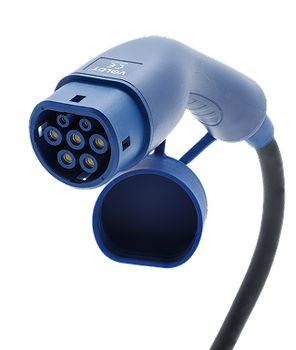
Using silver-plated copper contacts helps reduce contact resistance and improve heat dissipation at these interfaces.
Furthermore, one-piece molded plugs avoid seams, screws, and adhesive joints that can loosen over time due to vibration and temperature cycling. This design supports higher ingress protection ratings and reduces the risk of moisture reaching internal conductors.
Flexibility and Conductor Stranding
A 6 mm² conductor can be constructed from many fine strands to improve cable flexibility and resistance to metal fatigue.
For users, this means a cable that coils more easily and remains manageable in cold weather. For the cable itself, it means reduced internal stress at bend points, contributing to a longer service life.
Bringing It All Together
Charging performance and safety are shaped by a combination of factors including conductor cross-section, material choice, insulation chemistry, connector design, and manufacturing precision.
While choosing a larger cross-section and higher-quality insulation does not necessarily increase charging speed, it ensures that charging remains stable and predictable over many years of use.
At Voldt®, this philosophy translates into charging cables designed not just to meet specifications, but to perform consistently under real European charging conditions, year after year.