



Choosing the right charging cable for your electric car can feel confusing, especially if you are new to EV ownership. Single-phase or three-phase? How many amps do you actually need? And what is the difference between a Type 2 charging cable and a so-called “granny charger”? These are questions we hear every day, and the answers directly affect both charging speed and safety.
Key Takeaways
- Choosing the right EV charging cable affects both charging speed and safety. Picking the wrong cable can slow down charging or under-utilise your car’s onboard charger.
- Type 2 is the standard AC charging cable in the UK and Europe. This is the most common cable you’ll need for everyday charging at home and most public AC chargers.
- CCS2 (Combined Charging System) cables are used for DC fast charging, but these are always permanently attached to rapid chargers - you don’t need to buy one yourself.
- A “granny charger” (Type 2 to household plug) is only for emergency use. Standard domestic sockets are not designed for regular high-current charging and can overheat.
- Match the cable to your car’s charging capability.
- Single-phase cables suit cars with lower power AC onboard chargers.
- Three-phase cables allow faster AC charging where supported by the vehicle and charger.
- Having your own cable increases flexibility and reliability. Bringing your own charging cable ensures you can charge at public chargers that don’t include a tethered cable.
Many drivers end up buying the first cable they come across. If that cable does not match your car’s onboard charger or your home charging setup, you may charge much slower than necessary or pay for capacity your car cannot use. Whether you are looking for a Type 2 charging cable for everyday use at public charge points or trying to understand how a CCS connector works on long journeys, this guide helps you make the right choice and get the most out of your electric vehicle.
The most common EV charging options in the UK
In the United Kingdom – as in most of Europe – you will mainly encounter three different ways of charging your electric car. Understanding the difference is the first step towards choosing the right EV charging cable equipment.
Type 2 charging cable (AC charging)
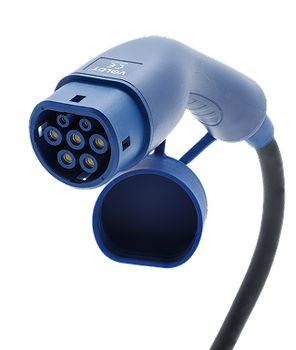
Type 2 is the standard connector for AC charging across the UK and Europe. When you see a public charging point in a city centre, supermarket car park or a home wallbox, it will almost always use a Type 2 socket. This cable is used for AC (alternating current) charging and is the one you normally carry in your boot.
Without a Type 2 charging cable, you cannot use the many public charge points where the cable is not permanently attached to the charging station.
CCS2 (DC fast charging)
When you are on a longer journey and need to charge quickly, DC fast charging comes into play. This uses a CCS (Combined Charging System) connector, which combines the standard Type 2 connector with two additional DC pins. This allows rapid charging directly to the battery, typically from 10% to 80% in a short time.
Important to know: you never need to buy a CCS cable yourself. At DC rapid chargers, the cable is always thick, heavy and permanently attached to the charging station for safety reasons.
Granny charger (emergency charging via a socket)
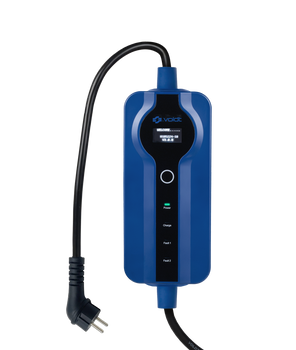
Many electric cars are delivered with a so-called granny charger. It has a Type 2 plug for the car on one end and a standard household plug on the other. While this can be useful in emergencies, it is not designed for regular use.
Domestic sockets are not intended to deliver high current for many hours in a row, which increases the risk of overheating. Use a granny charger only when no other charging option is available.
Read also our blog about 'Types of electric car charging cables'.
Choosing a charging cable based on your car model
A cable fitting physically into your car is not enough. To achieve the fastest possible AC charging, the cable must match your car’s onboard charger. Some vehicles can only charge on a single phase, while others support three-phase charging.
For example, if your car supports 11 kW three-phase charging but you use a cable designed for single-phase charging, your charging time can be up to three times longer than necessary.
You can find charging cables tailored to your vehicle here:
Voldt® Single-phase vs three-phase charging – what does it mean?
This is the most technical part, but also the most important for charging speed.
Single-phase charging works like filling a tank with one hose. It gets the job done, but relatively slowly. Many plug-in hybrids and older electric cars use single-phase charging, typically around 3.7 kW or 7.4 kW.
Three-phase charging is like using three hoses at the same time. It is significantly faster. Most modern electric cars support three-phase charging at 11 kW, and some even up to 22 kW.
As a general rule, choosing a three-phase 22 kW Type 2 cable is the most future-proof option. A high-capacity cable will also work perfectly with cars that only charge on one phase, while a lower-capacity cable can limit a car that is capable of charging faster. This way, you are covered regardless of your current car or the charging point you encounter.
When do you need an adapter?
In an ideal world, all charging connectors would be the same. In reality, there are situations where a standard Type 2 cable is not enough.
Older electric cars may use a different connector, such as Type 1, which requires a specific cable to connect to modern charging points. When travelling, you may encounter industrial sockets or different plug types, for example at campsites or older installations. Imported vehicles from outside Europe can also have non-standard connectors that require a dedicated solution.
In these cases, the right adapter allows you to charge safely and correctly. You can find suitable options in the EV charging adapters collection.
Ready to choose the right charging cable?
Having your own charging cable gives you freedom and flexibility. You are not dependent on whether a cable is available at a public charging station, and you can charge reliably when visiting friends, family or travelling.
Choose a cable at Voldt® that matches your car and charging setup, and you will charge safely, efficiently and without unnecessary compromises – both at home and on the road.
Voldt® Single-phase vs three-phase charging – what does it mean?
This is the most technical part, but also the most important for charging speed.
Single-phase charging works like filling a tank with one hose. It gets the job done, but relatively slowly. Many plug-in hybrids and older electric cars use single-phase charging, typically around 3.7 kW or 7.4 kW.
Three-phase charging is like using three hoses at the same time. It is significantly faster. Most modern electric cars support three-phase charging at 11 kW, and some even up to 22 kW.
As a general rule, choosing a three-phase 22 kW Type 2 cable is the most future-proof option. A high-capacity cable will also work perfectly with cars that only charge on one phase, while a lower-capacity cable can limit a car that is capable of charging faster. This way, you are covered regardless of your current car or the charging point you encounter.
When do you need an adapter?
In an ideal world, all charging connectors would be the same. In reality, there are situations where a standard Type 2 cable is not enough.
Older electric cars may use a different connector, such as Type 1, which requires a specific cable to connect to modern charging points. When travelling, you may encounter industrial sockets or different plug types, for example at campsites or older installations. Imported vehicles from outside Europe can also have non-standard connectors that require a dedicated solution.
In these cases, the right adapter allows you to charge safely and correctly. You can find suitable options in the EV charging adapters collection.
Ready to choose the right charging cable?
Having your own charging cable gives you freedom and flexibility. You are not dependent on whether a cable is available at a public charging station, and you can charge reliably when visiting friends, family or travelling.
Choose a cable at Voldt®, that matches your car and charging setup, and you will charge safely, efficiently and without unnecessary compromises – both at home and on the road.