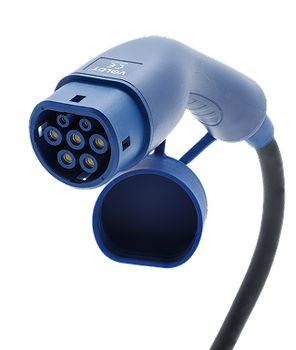
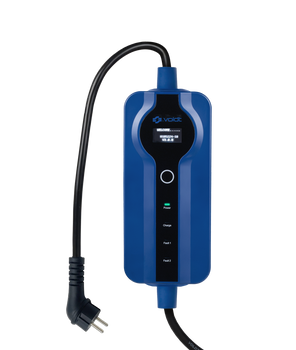
Mercedes eCitan Charging cable

Mercedes eCitan Charging cable


22kW
The Mercedes eCitan has a charging capacity of 22kW. So we recommend using a charging cable of atleast 22kW for optimal charging speeds.

22kW cable compatible
Please be aware that the 22kW cable is also perfectly capable of charging at a lower capacity.

Do you need to charge at a charging station or wall socket?

Mercedes eCitan Specifications

22kW

32A

3 Phase

Type 2

45kWh

383km

139km/h

2 hours

Mercedes eCitan compatible portable charger

Our portable chargers also lets you charge the Mercedes eCitan at a regular or a CEE wall socket.

What customers say about Voldt

Mercedes eCitan Charging cable

  • Mercedes eCitan Connector type:

  • Mercedes eCitan Mobile versus fixed charging:

  • Mercedes eCitan Charging speed:

  • Discover the range and charging capabilities of the Mercedes eCitan

  • Connecting your Mercedes eCitan to a charging station or outlet

For those considering buying a charging cable for the Mercedes eCitan, or simply looking for more information on the best way to charge this electric car, it is essential to know the compatibility and specifications well. And with the above details, you are already well on your way. When looking for the perfect charging cable for your Mercedes eCitan in our webshop, you can rely on these details to make the right choice.

Is the specific EV charging cable you are looking for still not among them? Then take a look at our full range of type 2 charging cables or all our mode 3 charging cables or check out our range of portable charging cables.

Couldn't find the right charger?

Thank you for submitting your form!

We appreciate your interest and will review your information as soon as possible.

Our team is dedicated to providing excellent customer service, and we will do our best to respond promptly.

Collection: Mercedes eCitan Charging cable

The Mercedes-Benz eCitan is the fully electric small van, sold as a Panel Van in two lengths and as a Tourer for passenger work. The compact Panel Van measures 4,498 mm and carries 2.9 cubic metres and up to 544 kg; the long version measures 4,922 mm and takes 3.7 cubic metres and up to 722 kg, both figures close enough to the diesel Citan that the switch costs you nothing in capability. An externally excited synchronous motor drives the front wheels with 90 kW and 245 Nm, and the 45 kWh usable battery sits in the underbody ahead of the rear axle, giving 266 to 283 km on the WLTP cycle for the Panel Van and up to 284 km for the Tourer. The CCS2 socket is at the front, behind the Mercedes star in the centre of the grille. AC charging is 11 kW as standard, with 22 kW available as an option, and DC rapid charging runs to 80 kW for a 10 to 80 per cent top-up in 38 minutes.

What the 22 kW option changes

Most electric vans charge at 11 kW and are done in four and a half hours, which is fine when the vehicle stops for the night. The eCitan can be ordered with a 22 kW onboard charger instead, and that halves it: a full charge in around two hours. That is a different kind of number. Two hours is a long lunch, a loading stop, a morning at a job. It turns the middle of the day into charging time rather than something you plan around, and on a vehicle that does two runs a day it is the difference between finishing and not.

The rest is straightforward. At 11 kW a full charge takes around four and a half hours. On a single-phase supply the van draws 32A on one phase for 7.4 kW, which is around six and a half hours, and unlike many 11 kW three-phase chargers this one genuinely takes the full 32A rather than dropping to 16A. DC is there for the days that go wrong: 80 kW, and 10 to 80 per cent in 38 minutes while you have a coffee.

Which cable, and why 22 kW is the safe answer

Because the 22 kW charger is an option rather than standard, a lot of eCitans on the road have it and a lot do not, and the two want different things from a cable. Our 22 kW Type 2 cable is the one we recommend either way. It carries 32A per conductor, so it delivers 22 kW to a van with the upgrade at a three-phase supply, 11 kW to a standard van, and the full 7.4 kW on a single phase at home or at a small depot. British homes and a good many yards are single-phase, and that last figure is where the difference shows: a 16A-per-conductor cable would hold the same session to 3.7 kW and turn six and a half hours into twelve.

An 11 kW cable is a sound choice if you know your van is the standard 11 kW spec and you charge on three phases, where it reaches the same rate in a lighter cable. On length, the eCitan is unusual: the socket is at the front, not the side or the rear. Park nose-in to the wall, which is how most vans end up in a bay anyway, and the run is short, so 6 metres covers it. Eight metres is the sensible default if the van reverses in, if the charge point sits to one side, or if the same cable has to reach more than one bay. Ten and fifteen metres are for shared yards, on-street parking and multi-vehicle installations where nobody chooses their own space.

Charging away from the depot

Work does not always happen where the chargers are. Our 22 kW portable charger plugs into a 32A red commando socket and carries the same 32A per conductor as the fixed cable, so a van with the 22 kW upgrade fills in around two hours and a standard van in around four and a half. Red sockets are common on the sort of premises this van visits: workshops, industrial units, builders' yards, event sites. For campsites, marinas and anywhere on a blue hookup, the blue 16A commando charger runs at 3.7 kW and fills the battery across roughly twelve hours, which an overnight stop covers.

Where the only supply is a household socket, the three-pin portable charger adjusts from 8A to 13A and draws up to 2.8 kW, within the limits of what the circuit can sustain. A full charge takes around seventeen hours, so it suits a van parked at home from Friday evening or standing over a weekend rather than a working night. A built-in thermal sensor watches the temperature at the plug and eases the current back automatically if the socket runs warm, which counts for more when you are drawing from unfamiliar wiring at a customer's premises. One thing worth saying plainly about all three: a cable that gets plugged in twice a day, handled by whoever is on shift, dropped on gravel and coiled away wet has a harder life than one that lives in a garage.

One standard across the entire range

Every Voldt® cable is CE, UKCA and TÜV certified and made to automotive industry quality standards. The connectors are single-piece moulded units with no glue and no mechanical fasteners, housed in IP67-rated bodies tested from −30°C to +50°C. Conductors are 100% copper with silver-plated contacts, and every cable is rated beyond 10,000 connection cycles, which at two plug-ins a day is more than a decade of use. Three-year warranty, 100-day returns, free shipping across Europe.