



Roughly one in four new cars registered in the UK last year was fully electric, yet most campsites were wired decades before anyone imagined plugging in a car. This guide covers what you'll actually find on site, which cables and adapters to pack, and how to make the most of an overnight charge, so you can spend your time walking, cooking, and doing very little rather than worrying about range.
| Key insight | What it means for you |
|---|---|
| Most UK campsites use blue CEE hook-up bollards, not domestic sockets | A portable charger with a CEE blue plug is the single most useful piece of EV charging equipment you can pack. It plugs straight into what most sites already provide. |
| Bollard amperage varies: 6A, 10A, or 16A | Choose a portable charger with adjustable amperage (8A–16A) so you can dial it down to match the site's capacity and avoid tripping breakers. |
| Dedicated Type 2 EV charging posts are growing but not guaranteed | The Caravan and Motorhome Club, National Trust, and larger holiday parks are adding 7–22 kW posts. Carry a portable charger as backup regardless. |
| Charging from your caravan's internal sockets is prohibited at most sites | The internal wiring is not rated for sustained high-current loads. It creates a genuine fire risk. Always use a dedicated portable charger plugged directly into the bollard. |
| V2L-capable cars double as silent generators | If your car supports Vehicle-to-Load (Hyundai, Kia, MG, BYD, and others), a V2L adapter lets you power camping appliances directly from the car battery: lights, a fridge, a kettle, a laptop. |
What charging options exist at UK campsites?
UK campsites typically offer one of three setups. Understanding which one your site provides determines exactly which equipment you need to bring.
1. The standard electric hook-up bollard
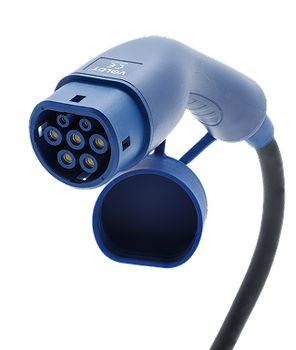
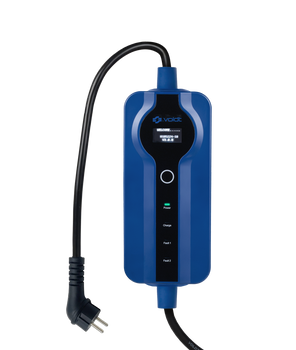
This is the most common arrangement. The blue CEE socket (formally IEC 60309, often called a "commando" plug) delivers single-phase power, usually rated at 16 amps. Most caravanners and motorhomers already own a hook-up cable for this connection. For EV charging, you need a portable charger with a CEE blue plug on the power side and a Type 2 connector on the car side. At 16A, you will charge at approximately 3.7 kW, enough to add around 12–15 miles of range per hour. Leave the car connected overnight and you will wake up to a full or near-full battery.
Important: some sites limit individual bollards to 10A or even 6A, particularly at smaller or older campgrounds. A good portable charger with an adjustable amperage setting lets you dial down to match the site's capacity, avoiding tripped breakers and awkward conversations with the warden.
2. Dedicated EV charging posts
A growing number of sites, particularly holiday parks and Club-operated campgrounds, have installed dedicated Type 2 EV charging posts rated at 7 kW or 22 kW. These work like any public charging station: you plug in with a standard Type 2 cable, tap a card or scan an app, and charge at a set rate per kWh. The Caravan and Motorhome Club has been rolling these out across its network, and the National Trust now offers EV charging at many of its campsites and holiday cottages.
If your campsite has these, a regular Type 2 charging cable is all you need. However, availability is not guaranteed, especially during peak season, so carrying a portable charger as backup remains sensible.
3. The three-pin domestic socket
Some sites, particularly smaller independent campgrounds, Certified Locations (CLs), and farm stays, may only offer a standard UK three-pin socket. Charging from a domestic socket is slow (approximately 2.8 kW at 13A, or around 10–12 miles of range per hour), but over a multi-night stay it adds up to a meaningful charge. You need a portable charger with a UK three-pin plug for this scenario.
What to pack: the Voldt® camping charging kit
Rather than hoping the campsite has exactly the right setup, the practical approach is to carry a small kit that covers every scenario you might encounter.
| Product | Max output | When you need it |
|---|---|---|
|
Voldt® Portable Charger CEE 1 phase | 8A–16A | 3.7 kW |
3.7 kW | Your primary campsite charger. Plugs directly into the blue CEE hook-up bollard found at most UK sites. |
|
Voldt® 3-Pin Granny Charger 8A–13A | 2.8 kW |
2.8 kW | For sites with only a domestic three-pin socket: CLs, farm stays, holiday cottages. Also doubles as a home charger. |
|
V2L Adapter Vehicle-to-Load |
up to 3.6 kW | If your car supports V2L (Hyundai, Kia, MG, BYD, and others), this lets you power camping appliances directly from the car battery. |
The essential pairing: the CEE portable charger (for campsite bollards) plus the 3-pin charger (for domestic sockets). Between these two, you can charge at virtually any UK campsite or accommodation. Add a V2L adapter if your car supports Vehicle-to-Load, and you can power camping appliances directly from the car battery at off-grid pitches.
Before you book: checking the charging situation
Ask the campsite directly. "Do you have EV charging?" is not specific enough. Ask whether they have a dedicated EV charging post (Type 2) or whether you will be charging via the standard hook-up bollard. Ask what amperage the bollards are rated at. If they say 6A, factor in a slow overnight charge (roughly 1.4 kW) and plan accordingly.
Use apps and booking filters. Pitchup.com now includes EV charging as a searchable amenity. The ACSI Eurocampings app marks campsite charging facilities across Europe. Zap-Map and PlugShare show public charging points near campsites for topping up en route or as a backup plan.
Check the Club networks. Both the Caravan and Motorhome Club and the Camping and Caravanning Club publish which of their sites have dedicated EV charging posts, and both are actively expanding their networks.
Plan your route. Arrive with a reasonable state of charge. The UK's public charging network now exceeds 120,000 points, so topping up en route is straightforward. Zap-Map is the standard route-planning tool for UK EV drivers.
On site: practical tips for campsite charging
Safety and etiquette
Never charge your car by running a cable from your caravan or motorhome's internal sockets. The internal wiring is not rated for sustained high-current loads, and doing so creates a real fire risk. Most sites now explicitly prohibit this. Use a dedicated portable charger plugged directly into the hook-up bollard or a dedicated charging post.
Keep cables tidy and out of walkways. If you need a longer reach, choose a longer cable (Voldt® portable chargers are available in 5 and 10 metre lengths) rather than using extension leads, which are not rated for EV charging loads.
Making the most of overnight charging
Even at a modest 10A (2.3 kW), an eight-hour overnight charge adds roughly 18–20 kWh to your battery, enough for 60–80 miles depending on your car. At the full 16A (3.7 kW), that same eight hours gives you around 30 kWh, covering 100–120 miles. For most camping holidays, where daily driving is short, this is more than enough.
Use the Voldt® app to set a delayed charge start, taking advantage of off-peak hours if the site meters electricity separately. The app also lets you monitor your session in real time from your tent or caravan.
V2L: powering your campsite from your car
Vehicle-to-Load technology turns your EV's battery into a portable power station. If your car supports V2L (the Hyundai Ioniq 5, Kia EV6, MG MG4, BYD Atto 3, and others do), a V2L adapter lets you run camping essentials directly from the car: LED lights, a cool box, a phone charger, a laptop, even a low-wattage kettle. This is particularly useful at off-grid pitches or wild camping spots where no mains power is available at all.
A 64 kWh car battery could power a 100W fridge, a 10W LED light, and occasional phone charging for several days before you would notice a meaningful drop in driving range. The key is to use V2L judiciously and keep an eye on your state of charge if you need to drive the next day.
If your site has no charging at all
Charge before you arrive. Top up at a public rapid charger en route. A 20-minute stop at a 150 kW rapid charger adds roughly 60 miles of range.
Find a public charger nearby. Many village car parks, pubs, and National Trust properties now have public charging points. Zap-Map will show you what is within a few miles of your campsite.
Use V2L sparingly. If your car supports it, V2L can keep your essential devices running for the duration of a short off-grid stay without needing any external power at all.
Heading to the Continent? A note on European sockets
If your camping plans extend beyond the UK, European campsites use the same blue CEE hook-up system but domestic sockets differ. France, Germany, and most of continental Europe use the Schuko (Type F) socket rather than the UK three-pin. The CEE portable charger works across the Channel without any changes, but for domestic socket situations you will need a Schuko-plug charger instead of the UK 3-pin version.
We publish separate, localised camping charging guides for each of our European markets, covering country-specific apps, socket types, and campsite infrastructure. Check the Voldt® blog for your destination country.
Camping abroad: what to expect across the Channel
Camping in the UK is one thing. Take the ferry or Eurotunnel to the continent, and the infrastructure changes entirely. European campsites use the blue CEE bollard as standard, and domestic sockets are Schuko (Type F) rather than UK 3-pin. The Voldt® CEE portable charger covers you on every continental campsite. Here's what you'll find in the most popular destinations.
| Country | Domestic socket | Campsites with EV charger | Useful app |
|---|---|---|---|
| France | Schuko (Type E/F, 16A) | ~19% | Chargemap |
| Spain | Schuko (Type F), often 10A | ~22% | Electromaps |
| Italy | Schuko + Type L (often 10A in older buildings) | ~24% | Enel X Way, Be Charge |
| Germany | Schuko (Type F, 16A) | ~15% | EnBW mobility+, ADAC |
| Netherlands | Schuko (Type F, 16A) | ~36% | Chargemap, PlugShare |
On the continent, the Voldt® CEE portable charger connects directly to the blue CEE bollard found on virtually every European campsite. Note that Schuko sockets are not compatible with a UK 3-pin plug: this is where the CEE charger earns its place in your boot.
Quick reference: UK campsite charging at a glance
| Socket type | Typical max | Overnight (8 hrs) | You need |
|---|---|---|---|
| Blue CEE bollard (16A) | 3.7 kW | ~30 kWh / 100–120 mi | Voldt® CEE portable charger |
| UK 3-pin socket (13A) | 2.8 kW | ~22 kWh / 70–90 mi | Voldt® 3-Pin Granny Charger |
| Dedicated Type 2 post | 7–22 kW | Full charge in 3–8 hrs | Standard Type 2 cable |
Why Voldt®
Voldt® supplies charging cables, portable chargers, adapters, and V2L accessories for every charging scenario, at the campsite, at home, or on the road. All products are CE, UKCA, and TÜV certified, IP67 rated for complete protection against dust and water (rain, puddles, morning dew: none of it is a problem), and backed by a 3-year warranty. If something is not right, our 100-day hassle-free return policy has you covered. Free shipping on all UK orders, with same-day dispatch on weekday orders placed before 9 PM.