



Published 06/11/2026 · By Voldt® product team
ISO 15118 is the standard that lets an electric car and a charger exchange data through the charging cable. It uses the same thin signal wire that every Type 2 charge already relies on. DC rapid charging can’t work without it, although UK rules don’t require it.

The narrowest part sets the flow
Cable
rated 32 A
Charge point
offers 16 A
Car
accepts 32 A
16 A
Charging runs at the lowest limit: 16 A, about 11 kW on three phases.
Key points

Does every charge use ISO 15118?
AC charging works without it.
Does rapid charging need it?
A DC charge can’t start without it or its older version, DIN SPEC 70121.
Does your cable need to support it?
The cable only passes the signal along.
Do UK rules require it?
Neither the home nor the public charger rules mention it.
01 · The basics
What is ISO 15118 and how does it work?
It lets the car and the charger share real information, such as how much power each can handle and how full the battery is.
Every Type 2 plug has two small signal pins next to the big power pins. Even without ISO 15118, the charger and the car use one of them, the Control Pilot (CP), to talk in a very simple way. The charger sends a fast on-off signal, and the length of each “on” tells the car how much current it may take. The car answers by changing the voltage when it’s ready to charge.
Fig. 1
One wire, two signals
Basic on-off signal, 1 kHz
ISO 15118 data, 1,8 to 30 MHz
Longer pulse, more current
10%
6 A
26,7%
16 A
53,3%
32 A
5%
start data
Source: IEC 61851-1:2017, Annex A · ISO 15118-3
ISO 15118 adds a second, much richer conversation on the same wire. Small modems in the car and the charger send data at a far higher frequency than the on-off signal, so the two don’t get in each other’s way. The basic signal can only say how much current is available. A very short pulse of 5% is the charger’s signal to start this data link. With ISO 15118, the car and charger can agree on limits, share the battery level and plan the charge around your departure time. The 2022 version, ISO 15118-20, adds charging in both directions.
02 · Your cable
How does your charging cable talk to the charger through CP and PP?
How much current it can safely carry. A small resistor inside the plug does the talking.
A charging cable has no chip or electronics inside, but it still tells the charger something important. Each plug has a small resistor on the Proximity Pilot (PP) pin, and the charger measures it the moment you plug in. Each value stands for a rating: 1,5 kΩ means 13 A, 680 Ω means 20 A, 220 Ω means 32 A and 100 Ω means 63 A (IEC 61851-1). The charger never sends more current than that rating allows.
Fig. 2
What the plug’s resistor tells the charger
Resistor in the plug
Current the charger allows
1,5 kΩ
13 A
680 Ω
20 A
220 Ω
32 A
100 Ω
63 A
To scale: the smaller the resistor, the higher the rating.
Source: IEC 61851-1:2017, Annex B
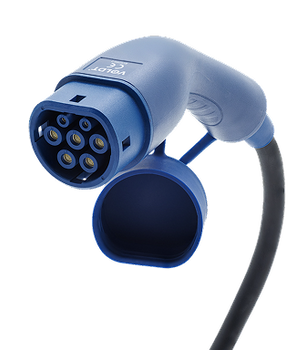
Apart from that, the cable simply passes the signals along, unchanged. That makes the two signal pins the part to look after: they’re the smallest contacts in the plug, so water, dirt or a bent pin can stop a charge before it starts. Voldt® plug housings are moulded in one piece, with silver-plated copper pins.
Voldt® tip
Put the cap back on after every charge. Our cables come with it attached, and it keeps rain and dirt off the two signal pins.
03 · Rapid charging
Why does rapid charging need ISO 15118 or DIN SPEC 70121?
At a DC rapid charger, the car has to tell the charger exactly what to deliver, and only a data link can do that.
With AC charging, the car’s built-in charger turns the power into what the battery needs, so the charge point only has to say how much current is available. With DC rapid charging, that conversion happens inside the rapid charger and the power goes straight into the battery. The car has to ask for an exact voltage and current and keep adjusting as the battery fills. An on-off signal can’t carry that, so every CCS rapid charge uses ISO 15118 or its older German version, DIN SPEC 70121.
Fig. 3
A rapid charge, step by step
Connect
Switch to data
The charger gives the signal to start the data link.
Find the right charger
A quick test confirms which charger the cable is in.
Agree
Share limits
Car and charger tell each other their maximum voltage and current.
Prepare
Safety check
The charger tests its cable before any power flows.
Match the voltage
It raises its voltage to match the battery.
Charge
Steer the charge
The car keeps asking for the voltage and current it needs.
Finish
Stop
The car asks to stop and the current drops to zero.
Release the plug
It checks its power switches are open, then unlocks.
Source: ISO 15118-2 DC message sequence, simplified
Before any power flows, the charger checks that its cable is safe and matches its voltage to the battery. When the charge ends, the car checks that its own power switches have opened before it releases the plug. The cable on a rapid charger is tethered to it, so your own cable plays no part here.
04 · Troubleshooting
Why won’t my car start charging with a Type 2 cable?
With your own cable, check three things in order: the pins, any adapter and the charge point.
If nothing happens when you plug in, the car isn’t getting a clean signal from the small pins. Look at both ends of the cable for water, dirt, or a bent or blackened pin. Dry them and plug in again. Push each plug in all the way: a charge point with a socket locks the plug before it switches on, and a plug that isn’t fully in won’t lock.
An adapter adds extra contacts the signal has to pass through, so leave it out if you can. If a different cable works on the same charge point, the first cable is the problem, and one with a damaged pin should be replaced. If neither works, the fault lies with the charge point or the car, and the operator or your garage can check the error log.
Voldt® tip
Change one thing at a time when you test: swap the cable or the charge point, never both at once.
05 · UK rules
Do UK rules require ISO 15118 on home and public chargers?
No. UK rules say what home and public chargers must do, but not how they talk to the car.
Home and workplace chargers sold in Great Britain since 30 June 2022 must be smart under the Electric Vehicles (Smart Charge Points) Regulations 2021. They have to keep working if you switch energy supplier, charge off-peak by default and add a short random delay before starting, so that not every car on the street starts at once. Public chargers follow the Public Charge Point Regulations 2023: contactless payment on new chargers of 8 kW and up, 99% reliability on rapid networks and prices shown in pence per kWh.
Fig. 4
What UK rules require
Names ISO 15118
Home and workplace chargers
Smart Charge Points Regulations 2021, since 30/06/2022
no
Public chargers
Public Charge Point Regulations 2023, since 24/11/2023
no
Rapid chargers, 50 kW and up
Public Charge Point Regulations 2023
no
Source: legislation.gov.uk and GOV.UK guidance, checked 10/10/2026
The EU has gone further: from 1 January 2027, new wallboxes and public chargers there must support ISO 15118-20 (Delegated Regulation (EU) 2025/656). In the UK it’s a feature to look for on the spec sheet, and rapid chargers use it or DIN SPEC 70121 anyway.
Voldt® tip
Choosing a home charger with vehicle-to-grid in mind? Check the spec sheet for ISO 15118-20, since no UK rule requires it, and check that your car supports it too.
Our verdict
Your car and the charger handle ISO 15118 between them. In the UK it matters most at rapid chargers. Your cable’s job is to carry the signal, so keep the plug capped and the pins in good shape.
1
Cap the plug after every charge
2
Push the plug home until it locks
3
Retire a cable with a damaged pin
Buy it if you charge at public AC charge points or a home charger with a socket
Skip it if you only use rapid chargers or a home charger with its own cable
The cable for public AC charging

Type 2 charging cable, 22 kW
32 A · 22 kW three-phase, 7,4 kW single-phase · 2 to 40 m
CP and PP are the signal pins. The PP resistor (220 Ω) tells the charger: 32 A.
Safe use and warranty
- Push both plugs fully home and wait for them to lock.
- Stop using a cable with cracked insulation, bent pins or scorch marks.
- Where your car’s manual differs from this guide, follow the manual.
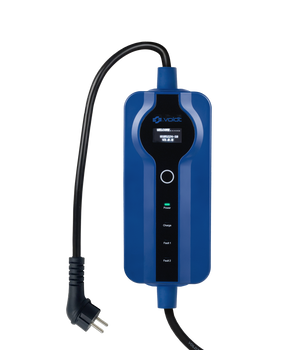
Voldt® cables and portable chargers are UKCA and CE marked and TÜV certified, with a 3-year warranty. Terms and exclusions are on the warranty and complaints page.
UKCA · CE · TÜV · IP67 · 3-year warranty · 100-day returns
Frequently asked questions about ISO 15118
Do I need a special cable for ISO 15118?
No. Any Type 2 cable made to the standard (IEC 62196-2) carries the signal, and the data travels along with it.
What’s the difference between ISO 15118-2 and ISO 15118-20?
Part 2 is the first version, from 2014. Part 20, from 2022, adds charging in both directions and stronger security.
Is DIN SPEC 70121 the same as ISO 15118?
It’s an older German version that only covers DC charging. Cars and chargers fall back to it when one of them doesn’t support ISO 15118.
What does a 5% pulse mean?
It’s the charger telling the car to switch to the data link, which happens at the start of every rapid charge.
Does ISO 15118 apply in the UK?
No UK rule requires it, but rapid chargers use it or DIN SPEC 70121 anyway.
Can an adapter block the signal?
Yes, if its contacts are dirty or worn, because the signals pass through them.
Voldt® product team, product development and support
Develops Voldt® charging cables and portable chargers and answers the questions that reach Voldt® support.