




Published 16.09.2026 · Reading time 12 min · By the Voldt® product team
Power
2.3 kW at 10 A from a standard 13 A socket; up to 2.8 kW at the 13 A setting on a socket built for it
Connection
BS 1363 three-pin plug, in-cable control box, Type 2 connector for the car
You need
A sound, earthed 13 A socket on a circuit that is not shared with heavy appliances
Limit
10 A for sustained charging from an ordinary socket; 13 A only on an EV-marked socket on its own circuit
Never
Charge through an extension lead, a multi-way adaptor, a travel adaptor or a plug-in timer
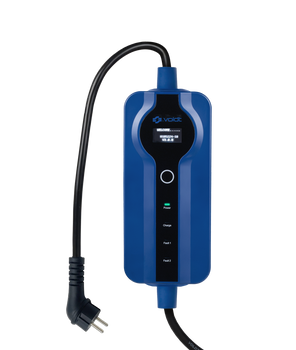
A granny charger is a portable EV charging cable with an ordinary three-pin plug at one end, a Type 2 connector at the other and a control box in between. You need an earthed 13 A socket in good condition and nothing else. The number that matters is 10 A: that is 2.3 kW, or roughly 6 to 8 miles of range for every hour the car is plugged in.
Below you will find what the name means, why a 13 A plug is normally run at 10 A, how many hours and pounds a charge takes for cars actually sold in the UK, how a granny charger compares with a 16 A socket or a wallbox, and the rules Electrical Safety First and the IET Wiring Regulations set for charging from a household socket.

A portable charger in practice: the control box hangs from an ordinary wall socket, with the cable running to the car's charge port.
Key points
| Question | Short answer |
| What is a granny charger? | A Mode 2 portable charging cable: 13 A three-pin plug, control box, Type 2 connector. Every EV with a Type 2 inlet can use one. See the technical card. |
| How fast does it charge? | 2.3 kW at 10 A, about 6 to 8 miles of range per hour, or 60 to 80 miles from a 10-hour night. See the model table. |
| Why not use the full 13 A? | A BS 1363 socket is rated for 13 A, not for 13 A without pause for ten hours. 10 A is the trade default for sustained charging; 13 A belongs on an EV-marked socket on its own circuit. See section 2. |
| What does a charge cost? | About £6 for a 10-hour session at 10 A at the October to December 2026 price cap of 26.32p/kWh. See the cost table. |
| Is it safe? | Yes, on a sound, earthed socket on a lightly loaded circuit. Electrical Safety First advises against extension leads and against daisy-chaining them in all circumstances. See safe use. |
| Granny charger or wallbox? | Under about 30 miles a day, a granny charger covers it. Above 40, a 7 kW wallbox. See the comparison table. |
What is a granny charger?
A granny charger is a Mode 2 charging cable: a 13 A three-pin plug, an in-cable control box and a Type 2 connector for the car, delivering 1.8 to 2.8 kW depending on the current you set.
The name is slang, and the usual explanation is that it is the cable you take when you visit your grandmother, whose house has sockets but no charge point. The trade uses drier words for the same thing: Mode 2 charging cable, portable EV charger, 3-pin EV charger, EVSE. Under IEC 61851-1, Mode 2 means charging from a standard household socket with the protection built into the cable instead of into the wall. Whether your car can use one is covered in is my EV suitable for charging from a normal outlet; every EV with a Type 2 inlet can.
Portable chargers also exist with a blue 16 A industrial plug for campsites, marinas and dedicated sockets. This article is about the three-pin version only: the one that plugs into the socket you already have and needs nothing installed.
That protection sits in the control box, the plastic block a short way down the cable from the plug. It is an in-cable control and protection device, or IC-CPD, to IEC 62752. Before any power flows it checks that the socket is earthed. While charging it watches for residual current, including DC fault current, and switches off the moment it sees any. And it tells the car how much current it may draw. The car's onboard charger does the conversion to DC and fills the battery; the box only controls and protects.
The current setting is the one thing you actively choose. A fixed unit sits at one value, usually 10 A. An adjustable unit lets you step between 8 and 13 A to suit the socket in front of you. The plug on the Voldt® granny charger also has a temperature sensor: if the plug gets too hot, the charger drops the current. Section 2 explains why the top setting is the one you will use least.
Technical card: Voldt® 3-pin granny charger
Connection
BS 1363 13 A plug to Type 2 connector (IEC 62196-2)
Charging mode
Mode 2 to IEC 61851-1, with IC-CPD to IEC 62752
Current settings
Adjustable from 8 to 13 A
Output power
1.8 kW at 8 A, 2.3 kW at 10 A, up to 2.8 kW at 13 A
Voltage
230 V single-phase
Protection
Earth check before start, residual current protection 30 mA AC plus 6 mA DC, over- and under-voltage cut-off; plug temperature sensor that drops the charging current if the plug gets too hot
Weather rating
IP67 control box and connector
Cable length
5, 10, 15 or 20 m
Installation required
None on an existing sound, earthed socket. Section 2 covers when a dedicated socket is worth having
Certification
CE, UKCA, TÜV
Voldt® product
Voldt® tip
Before your first overnight session, feel the plug and the socket face after half an hour at 10 A. Warm is normal. Too hot to keep your hand on is not: stop, and have the socket looked at before you charge from it again. A tired socket gives itself away in the first hour if you check.
Why does a 13 A plug give you 10 A of charging?
A BS 1363 socket is rated to supply 13 A, not to supply 13 A without pause for ten hours: 10 A is the current the trade has settled on for sustained charging from an ordinary socket, and 13 A belongs on a socket built and wired for it.
A kettle draws about 13 A for three minutes. A tumble dryer draws around 10 A and cycles its heater on and off. EV charging is different: the load is constant, for as long as the car takes. Constant current warms the plug pins, the socket contacts and the terminal screws behind the faceplate. A socket in good condition takes it. A 20-year-old outdoor socket with slightly sprung contacts runs warmer, and the warmth speeds up the wear that caused it.
Electrical Safety First tells drivers to have their wiring checked before charging from a 13 A socket, because older wiring may not cope with the demand of charging overnight. No UK law sets a maximum current for charging from a socket; the 10 A convention comes from the trade and the cable makers, and it leaves a margin below the socket's rating for the reason above.
Two things move the line. The first is the socket. BS 1363-2 covers socket-outlets marked "EV", designed for sustained 13 A load. The second is the circuit behind it. A charging point installed for the purpose falls under Section 722 of BS 7671, the IET Wiring Regulations: its own circuit from the consumer unit and a 30 mA RCD that also detects DC fault current. An EV-marked socket on a Section 722 circuit is where the 13 A setting makes sense. Anywhere else, leave the unit at 10 A.
Setting

Older wiring, a socket shared with other appliances, a holiday let or a relative's house where you cannot vouch for the installation
Least load on the socket; Electrical Safety First: have wiring checked before charging from a 13 A socket
A sound, earthed 13 A socket on a lightly loaded circuit. The setting for routine overnight charging
Trade convention for sustained charging from BS 1363 sockets
Only an EV-marked BS 1363-2 socket on its own circuit to BS 7671 Section 722
BS 1363-2; BS 7671 Section 722
Voldt® tip
A UK ring circuit is shared by every socket in that part of the house, and at 10 A the charger takes nearly a third of a 32 A ring. Add a tumble dryer and a fan heater and the breaker trips at three in the morning. When a session keeps stopping, look at what else is on the circuit before you look at the charger; the fix is usually a different socket.
How long does a granny charger take, and what does it cost?
At 10 A about 2 kW reaches the battery, so a 10-hour night adds roughly 20 kWh, 60 to 80 miles of range, and costs about £6 at the October to December 2026 price cap.
The socket supplies 2.3 kW at 10 A. The onboard charger and the battery turn part of that into heat, proportionally more at low power than at high, so around 2.0 kW reaches the cells; the table assumes that, and 2.5 kW at the 13 A setting. Most drivers charge from about 20% to 80% rather than empty to full, so that is the span shown. Battery figures are the manufacturers' nominal capacities; what charging speed do I need for my EV has the same sums for wallboxes and public chargers.
| Model (UK spec) | Battery, kWh | 20 to 80% at 10 A | 20 to 80% at 13 A | 10-hour night at 10 A adds |
| Dacia Spring | 26.8 | 8 h | 6.5 h | 20% to full |
| Renault 5 E-Tech 52 kWh | 52 | 15.5 h | 12.5 h | 38% |
| BYD Dolphin | 60.4 | 18 h | 14.5 h | 33% |
| MG4 Long Range | 64 | 19 h | 15.5 h | 31% |
| Tesla Model Y Long Range (approx.) | 75 | 22.5 h | 18 h | 27% |
| Kia EV3 Long Range | 81.4 | 24.5 h | 19.5 h | 25% |
In practice: a 60 kWh car will not get a full charge from a granny charger in one night, and does not need one. Thirty miles a day uses 8 to 10 kWh, which the socket puts back in four to five hours. Tesla does not publish its battery capacities; the 75 kWh figure is the commonly quoted estimate.
| Session | Energy drawn from the socket | Cost at 26.32p/kWh |
| 1 hour at 10 A | 2.3 kWh | £0.61 |
| 10-hour night at 10 A | 23 kWh | £6.05 |
| 10-hour night at 13 A | 28 kWh | £7.37 |
| 20 to 80% on a 60 kWh battery (about 41 kWh from the socket) | 41 kWh | £10.79 |
The rate is the Ofgem price cap for 1 October to 31 December 2026, Great Britain average for Direct Debit customers, with no VAT on electricity in that period; the 54.83p daily standing charge is paid whether or not you charge. Per mile that works out at roughly 8 to 9p. An EV tariff changes the sum: at an off-peak rate of 8p, the same 23 kWh night costs £1.84. For the comparison with the kerbside, see why public kWh prices vary so much.
Granny charger, 16 A socket or wallbox: which do you need?
Under about 30 miles a day, a granny charger at 10 A on a sound socket does the job; above 40 miles, or whenever you need a full battery by morning, a 7 kW wallbox is the answer, and a 16 A industrial socket sits usefully between the two.
Criterion
Granny charger on a 13 A socket
Power
2.3 kW at 10 A; 2.8 kW at 13 A on an EV-marked socket
Range added in a 10-hour night
60 to 80 miles
Installation
None on an existing sound socket. An EV-marked outdoor socket on its own circuit is an electrician's job
Standards
IEC 61851-1 Mode 2, IEC 62752
Indicative cost, 2026
The charger only on an existing socket; an outdoor socket on its own circuit runs about £300 to £500 (2026 trade price guides)
Comes with you
Yes
16 A industrial socket + 16 A portable charger
Power
3.7 kW at 16 A
Range added in a 10-hour night
100 to 130 miles
Installation
Electrician: blue IEC 60309 socket on a dedicated circuit to BS 7671 Section 722
Standards
IEC 60309, BS 7671 Section 722
Indicative cost, 2026
A 16 A socket on its own circuit, about £300 to £500 (2026 trade price guides), plus the 16 A charger
Comes with you
Yes, wherever a 16 A socket exists: campsites, marinas
7 kW wallbox
Power
7.4 kW single-phase, the UK domestic standard
Range added in a 10-hour night
Most batteries from 20% to 80% in 5 to 7 hours
Installation
Electrician: dedicated circuit to Section 722, DNO notification, a charge point meeting the smart charge point regulations
Standards
BS 7671 Section 722; Electric Vehicles (Smart Charge Points) Regulations 2021
Indicative cost, 2026
About £800 to £1,200 installed (Checkatrade, 2026); the £500 grant applies only to renters, flat owners and landlords
Comes with you
No
The middle column is the one UK drivers overlook. A blue 16 A IEC 60309 "commando" socket on its own circuit gives 3.7 kW, 60% more than a granny charger at 10 A, for the cost of a socket and a circuit, and the same 16 A portable unit works at campsites and marinas. The single-phase versus three-phase question behind the wallbox column is in 1-phase vs 3-phase charging, 16 A vs 32 A; the wallbox decision itself is in mobile Type 2 charger or fixed wallbox. A socketed wallbox also needs its own Type 2 charging cable.
For the "best granny charger" question, these are the spec sheet lines that decide it:
What to compare
Adjustable current
Lets you match the socket: 8 A at a relative's, 10 A at home, 13 A on an EV-marked socket
Settings from 8 to 13 A, easy to change
Protection in the control box
The earth check and DC-sensitive residual current protection are what make socket charging safe
IEC 62752 named on the spec sheet; Mode 2 to IEC 61851-1; 30 mA AC plus 6 mA DC
Plug and cable
Plug and cable carry 10 to 13 A for hours at a stretch
BS 1363 plug with a 13 A BS 1362 fuse; conductor cross-section rated for 13 A continuous
Weather rating
Box and connector live outdoors
IP67 on box and connector
Length
Too short means an extension lead, the one thing you must not use
Measure socket to charge port with the car parked as you actually park it, then add a metre
Certification and warranty
Evidence that someone independent has tested it
CE, UKCA, TÜV; a multi-year warranty
Your situation, our advice
Advice
Under 30 miles a day, a sound outdoor socket, and you can park next to it
Granny charger at 10 A, plugged in every night. No installation
You rent, or a wallbox is not an option
Granny charger now. If the landlord agrees, an EV-marked outdoor socket on its own circuit later
40 miles a day or more, or two EVs on the drive
7 kW wallbox at home; keep the granny charger in the boot for trips and visits
You charge at relatives' houses or holiday lets
Granny charger at 8 or 10 A, socket checked first, never an extension lead
Our verdict
A granny charger at 10 A is a complete home charging solution for a low-mileage driver and a sensible backup for everyone else. Do not buy one to run through an extension lead, and do not buy a 13 A unit expecting 13 A from an ordinary socket: the 13 A setting is for an EV-marked socket on its own circuit and nowhere else. Above 40 miles a day, buy the wallbox and keep the granny charger for the boot.
Voldt® tip
If your tariff has a cheap overnight window, set the schedule in the car, never with a plug-in timer between socket and charger. A timer is one more set of contacts carrying 10 A for hours, and it cuts the supply without telling the car.
Safe use and warranty
- Charge from a sound, earthed BS 1363 socket in good condition. If you do not know the age or condition of the wiring, have it checked before the first overnight session, as Electrical Safety First advises.
- Never use a domestic extension lead, a multi-way adaptor or a travel adaptor, and never daisy-chain leads: Electrical Safety First advises against this in all circumstances because of the fire and electrocution risk. If the cable does not reach, move the car or the socket. Can you extend an EV charging cable covers the Type 2 end of the same question.
- Keep the plug and socket dry. An outdoor socket needs a weatherproof enclosure that keeps its IP rating with the lid closed over an inserted plug.
- Leave the unit at 10 A on any socket that is not an EV-marked BS 1363-2 outlet on its own circuit to BS 7671 Section 722.
- Stop charging and have the socket checked if the plug, socket or box becomes too hot to hold, smells of hot plastic or shows discolouration.
Voldt® portable chargers carry CE, UKCA and TÜV certification and an IP67 rating, with a 3-year warranty and 100-day returns. Warranty terms and any exclusions are set out in full on the warranty and complaints page.
Charging stops or will not start: causes and fixes
Most interruptions at a household socket come down to heat, a shared circuit or a missing earth; the table pairs each symptom with its fix.
Control box shows an earth fault and will not start+
Likely cause: The socket has no earth, or the earth connection is broken
Fix: Try another socket; have the first one checked by an electrician. Never bypass the earth check
Charging stops after an hour or two and the breaker has tripped+
Likely cause: The circuit is shared with a heavy appliance, or the MCB is old
Fix: Move to a socket on a lighter circuit, drop to 8 A, and ask an electrician about a dedicated socket
Charging stops during the night and the RCD has tripped+
Likely cause: Moisture in the plug or socket, or a fault in another appliance on the same RCD
Fix: Dry and inspect plug and socket; use a weatherproof outdoor socket; if it repeats, have the installation tested
Car shows a scheduled or delayed charge and does not start+
Likely cause: Departure time or off-peak schedule set in the car
Fix: Charging menu > charge now (or clear the schedule), then reconnect the cable
Charger drops to 8 A though you set 10 or 13 A+
Likely cause: The plug temperature sensor has cut the current because the plug was getting too hot
Fix: Let the plug cool and check the socket; a socket that keeps heating the plug needs replacing
Plug or socket hot to the touch+
Likely cause: Worn socket contacts or a loose terminal behind the faceplate
Fix: Stop. Replace the socket before charging from it again
Voldt® product team, product development and support
Develops the Voldt® range of portable chargers and Type 2 charging cables, designed and manufactured in Europe, and answers the technical questions that reach Voldt® support.
Frequently asked questions about granny chargers
Is the cable that came with my car a granny charger?+
Usually, yes. Most manufacturers supply a Mode 2 cable with a three-pin plug, often fixed at 10 A and sometimes at 8 A. A separate adjustable unit lets you leave one at home, keep one in the car, and pick the current for the socket in front of you.
Does the fuse in the plug protect the socket?+
No. The 13 A BS 1362 fuse in a UK plug protects the cable and the appliance against fault current; it does nothing about a socket slowly overheating at a steady 10 to 13 A. A blown fuse points to a fault: replace it like for like and find the cause before charging again.
What about heavy-duty extension leads sold as "EV-rated"?+
Electrical Safety First advises against charging through extension leads; where it gives any guidance at all, it is for an outdoor-rated lead, fully uncoiled, never daisy-chained. Our advice is stricter: an extension lead adds a second plug-and-socket joint carrying 10 A for hours, and the money is better spent towards a properly installed outdoor socket.
Can I leave it charging overnight and unattended?+
Yes, at 10 A on a sound, earthed socket on a lightly loaded circuit, with the plug and socket protected from rain. Check plug and socket temperature during your first few sessions; after that, treat it like any other appliance you leave running.
Does slow charging harm the battery?+
No. Slow AC charging generates little heat in the battery; heat and cell stress come mainly from rapid DC charging, and several manufacturers' manuals recommend AC charging for everyday use and DC for journeys.
Does it work in rain and frost?+
The control box and the Type 2 connector are IP67 and take rain without trouble. The socket is the weak point: use a weatherproof outdoor socket with a cover that closes over the plug, and keep the plug out of standing water. Frost does not affect charging; a cable frozen into a puddle is a different problem.
Can I use my UK granny charger in France or Spain?+
No. The BS 1363 plug does not fit continental sockets, and a travel adaptor is not built for 10 A over several hours. On the continent you need a Mode 2 unit with a CEE 7/7 Schuko-style plug, sold on our European stores. Our travel guide, travelling with Voldt® in the UK, covers what to pack.
Do I need a smart charger to use a cheap EV tariff?+
No. Off-peak tariffs bill by the clock, and your car's own charging schedule makes the granny charger start and stop inside the window. What you do need is a smart meter, which the supplier requires for the tariff.