



The UK had 121 171 public EV chargers on 1 July 2026, one for every 17 battery-electric cars (DfT). Nearly a quarter are rapid or ultra-rapid, at 50 kW and above. Under the Public Charge Point Regulations 2023, new chargers of 8 kW and above take contactless, and every public charger gives its price in pence per kWh.
Published 21/10/2026 · By Voldt® product team

121 171
public EV chargers in the UK, 1 July 2026 (DfT)
Public charger
Ready
Your rights at a UK public charger
Pay by contactless
New chargers from 8 kW, and every charger from 50 kW.
The price in pence per kWh
Shown before you start, connection fee included.
A 24/7 helpline
Free and staffed, and rapid networks must be 99% reliable.
Tap to pay · see the price first
Public Charge Point Regulations 2023 (GOV.UK).
01 · The count
How many public chargers does the UK have, and where?
121 171 on 1 July 2026, from 345,1 per 100 000 people in London to 60,0 in Northern Ireland.
The Department for Transport counts every public charger that operators report under the 2023 regulations. Of the 121 171 chargers on 1 July 2026, 49% were standard (3 to 8 kW), 27% standard plus (8 to 50 kW), 12% rapid (50 to 150 kW) and 12% ultra-rapid (150 kW and above) (DfT, 27 August 2026).
London has the most public chargers per head, yet the second-lowest rate of rapid ones, because much of its network is standard on-street charging. Scotland leads on rapid chargers with 59,1 per 100 000 people, and Northern Ireland has the fewest of both, at 60,0 and 19,3 (DfT).
Half the chargers (52%) are destination chargers in car parks and at shops and hotels, a third (33%) are on residential streets, and 11% are en-route chargers such as motorway services. Rural England and Wales hold 16,7% of chargers for 17,5% of the population (DfT).
Fig. 1
Public chargers per 100 000 residents, 1 July 2026

London
345,1
27,9
Scotland
231,6
59,1
Wales
185,5
42,8
United Kingdom
174,9
41,7
South West
156,7
49,5
North West
112,1
40,0
Northern Ireland
60,0
19,3
DfT, EV charging infrastructure statistics, 1 July 2026, Annex A. Selected areas.
02 · AC or DC
How do AC and DC chargers differ?
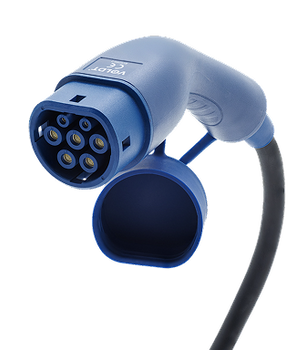
AC chargers feed your car's onboard charger, usually through your own Type 2 cable, while rapid DC chargers charge the battery directly at 50 kW and more through a fixed cable.
Most standard and standard plus chargers supply AC, and the charger built into your car converts it, so the car sets the ceiling: a car with a 7,4 kW onboard charger takes 7,4 kW from a 22 kW post. Public AC points installed or renewed since 17 November 2017 must offer Type 2 (Alternative Fuels Infrastructure Regulations 2017), and many street and car-park chargers have only a socket, so you plug in your own cable.
Rapid and ultra-rapid chargers convert the current themselves and send it straight to the battery. Their cable is fixed to the charger, with a CCS connector on new rapid chargers, and some older ones also carry CHAdeMO. How fast your car charges depends on its battery, its temperature and how full it is.
Fig. 2
Two kinds of public charger
Type 2 plug
AC
Standard and standard plus
Grid
AC charger
Onboard charger
Battery
Cable
Often none: bring a Type 2
Power
Up to 22 kW, capped by your car
CCS2 plug
DC
Rapid and ultra-rapid
Grid
Rapid charger
Onboard, not used
Battery
Cable
Fixed, CCS or CHAdeMO
Power
50 kW and more
Share of UK public chargers
Under 50 kW, 76%
50 kW and above, 24%
Alternative Fuels Infrastructure Regulations 2017. Shares: DfT, 1 July 2026. Plug faces simplified, not to scale.
03 · Paying
How do you pay at a UK public charger?
By contactless at new chargers of 8 kW and above and at every rapid charger, with the price in pence per kWh before you start.
The Public Charge Point Regulations 2023 came into force on 24 November 2023 and cover every public charger in the UK. Prices must be given in pence per kWh, including any connection fee, on the charger or through a separate device. Since 24 November 2024, new chargers of 8 kW and above and existing chargers of 50 kW and above must accept contactless (GOV.UK guidance).
The same rules require a free 24/7 staffed helpline, advertised at every charger, and 99% average reliability across each operator's rapid network every year. Since 24 November 2025, operators must also accept payment through at least one roaming provider, so one app or card works across several networks.
There is no single UK price to quote. Operators set their own, and app, subscription and contactless prices can differ, so compare the pence per kWh before you plug in.
Fig. 3
What a charging price is made of
Contactless
Maximum price shown before you start
App or charging card
Set by your provider, shown in the app
Public Charge Point Regulations 2023. Fees apply where charged.
Voldt® tip
Before a late-night session, note the helpline number on the charger. If the charger fails, the operator has to answer around the clock.
04 · No driveway
Can you charge an EV without a driveway?
Yes: a third of UK public chargers are on residential streets, and half are destination chargers in car parks and at shops.
On-street chargers suit overnight charging close to home. In London, much of the public network is standard on-street charging, which is why the capital has the most chargers per head (DfT). Elsewhere, destination chargers in car parks and at shops cover top-ups during the day.
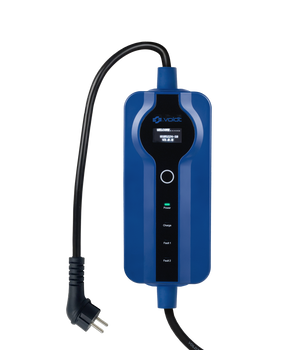
A granny charger from a 3-pin socket only works where you park on your own property next to the socket. Ask your council before you run any cable across a pavement, and never use an extension lead.
Voldt® tip
Measure from your car's charge port to where the post usually stands before you buy a cable. A port at the rear and a post at the front of the bay can need 7,5 m or more.
05 · Abroad
What changes when you charge in Europe?
The plugs stay the same, Type 2 and CCS, but EU rules decide how you pay, and each country counts its chargers in its own way.
Since 13 April 2024, every new public charger in the EU must let you charge without a contract, and new chargers of 50 kW and above take a bank card and show the price per kWh first (AFIR). Norway wrote the same rules into its own law in June 2026.
Our verdict
The UK network is dense in London and Scotland and thin in Northern Ireland, and paying is simple: contactless and pence per kWh. Keep a Type 2 cable in the boot.
1
Carry a Type 2 cable
2
Compare the pence per kWh
3
Move the car once it is full
Buy it if you use street posts, car parks or a wallbox with a socket
Skip it if you only use rapid chargers or a tethered wallbox
For street and car-park chargers

22 kW
three-phase
Type 2 charging cable, 22 kW
Three-phase, 32 A, 2 to 40 m
For AC chargers and wallboxes with a socket.
By your own 3-pin socket? The Voldt® granny charger plugs straight in.
Safe use and warranty
- Unroll the cable fully and keep it out of walkways.
- Stop using a cable with cracked insulation or bent pins.
- Where your car's manual differs, follow the manual.
Voldt® cables and granny chargers are CE and UKCA marked and TÜV certified, with a 3-year warranty. Terms are on the warranty and complaints page.
CE · UKCA · TÜV · IP67 · 3-year warranty · 100-day returns
Frequently asked questions about UK public charging
Do I need an app to charge?
Not at new chargers of 8 kW and above or at rapid chargers: they take contactless. Some older, slower chargers still need an app or an RFID card.
How do I report a broken charger?
Call the helpline shown on the charger. Every operator must run a free staffed helpline, 24 hours a day.
Why are rapid chargers rare in London?
Much of London's public network is standard on-street charging, built for overnight use. London has 27,9 rapid chargers per 100 000 people, against 41,7 for the UK (DfT).
Does my Type 2 cable work at rapid chargers?
No. Rapid chargers have their own fixed CCS or CHAdeMO cable. Your Type 2 cable is for AC chargers and wallboxes.
What is an overstay fee?
A per-minute charge some operators add when a car stays plugged in after charging ends. Check the charger or the app for it before you start.
Do UK rules apply to chargers in the EU?
No. EU countries follow AFIR: no contract needed, and card payment and the price per kWh up front at new chargers from 50 kW.
Voldt® product team, product development and support
Develops Voldt® charging cables and granny chargers and answers the questions that reach Voldt® support.