



What charging speed do I need for my EV?
How many kW do you need to charge your electric car? Many EV drivers focus on range, but charging speed determines how practical your car is in daily use. In this article, we explain in simple terms which charging speed suits your situation.
Key points
| Question | Short answer |
|---|---|
| What is charging speed? | The power at which your car charges, expressed in kilowatts (kW). The higher it is, the faster it charges. |
| How many kW do I need at home? | For most drivers, 7.4 kW is more than enough for daily home charging. |
| Does my car always need the fastest charger? | No. Most EV drivers charge at home overnight and rarely need fast chargers. |
| What does future-proofing mean for EV charging speed? | An 11 kW wallbox is future-proof for virtually all current and future EVs. |
| Does charging speed at a public charging station matter? | Yes, but only if you regularly want to top up quickly while on the road. |
| What does a faster home charger cost? | The difference between 7.4 kW and 11 kW is small; the installation requirements often determine the choice. |
What exactly does charging speed mean?
Charging speed is expressed in kilowatts (kW). Simply put: the more kW, the faster your battery is full. A standard household socket delivers around 2.3 kW. A home wallbox delivers 3.7 to 22 kW. A fast charger along the motorway delivers 50 to 350 kW.
But there is an important caveat: your car decides how many kW it accepts. A car with a maximum AC charging capacity of 7.4 kW will not charge faster if you connect it to a 22 kW wallbox. The charger at home should therefore be matched to the car, not the other way around. Always check the specifications of your own model before choosing a wallbox.
For beginners, the practical rule of thumb is simple: a full 60 kWh battery takes around 8 to 9 hours at 7.4 kW. That means plugging in in the evening and waking up to a full battery in the morning. For most drivers, that is exactly what they need.

How many kW do you actually need?
The answer depends on three things: how many kilometres you drive daily, how large your car’s battery is, and whether you also want to be able to top up while on the road. Below, we break this down by driving profile.
The daily commuter, up to 80 km per day
If you mainly drive between home and work and come home in the evening, a 7.4 kW wallbox is more than enough. You charge overnight, use part of the battery during the day, and the cycle repeats. You never need to run the battery completely empty in order to have it full again in the morning. A simple and affordable charging solution is fully sufficient.
The weekend driver and family car
If you drive little during the week but make longer trips at the weekend, home charging is still the foundation, but you also want to know where you can top up on the road. A 7.4 to 11 kW wallbox at home is ideal. At public charging stations, 11 kW (3-phase) is useful for longer stops, but fast chargers are rarely necessary unless you really drive long distances.
The long-distance driver
If you regularly drive 200 km or more per day, charging speed on the road becomes more important. You want a car that supports fast charging (50 kW or higher via DC), and at home you want to be able to replenish the battery quickly enough overnight. An 11 kW wallbox is then the minimum; some drivers choose 22 kW if their car supports it.
Overview: charging methods and speed
The table below compares the most commonly used charging methods by power, charging time for an average EV battery of 60 kWh, and the most common situation in which you use them.
| Charging method | Power | Charging time (60 kWh) | Realistic daily use |
|---|---|---|---|
| Household socket (Schuko) | 2.3 kW | Approx. 26 hours | Emergency solution, temporary |
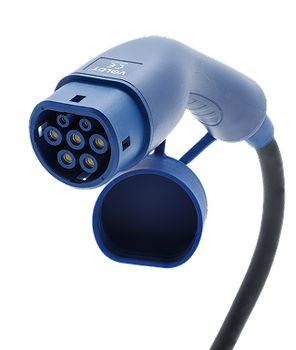
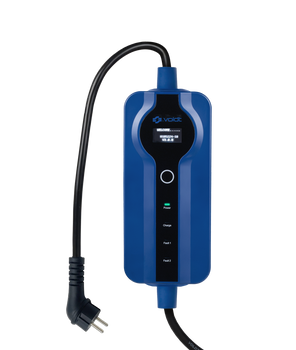
| Mobile Type 2 charger | 3.6 to 7.4 kW (Voldt®: 2.8 to 22 kW) | 8 to 12 hours (typical home use) | Home, flexible use |
| 1-phase wallbox | 3.7 to 7.4 kW (depending on connection) | Approx. 8 to 9 hours | Daily home charging |
| 3-phase wallbox | 11 to 22 kW | 3 to 6 hours | Home or work, faster charging |
| Public AC charger | 11 to 22 kW | 3 to 6 hours | Parking in the city or at work |
| Fast DC charger | 50 to 350 kW | 15 to 60 min | On the road, long trips |
Home charging vs public charging: what is realistic for a beginner?
Most beginner EV drivers overestimate how often they need a fast charger. Research repeatedly shows that more than 80 percent of all charging sessions take place at home or at work. Fast chargers are intended for use on the road, not as a replacement for home charging.
For a beginner, the recommendation is therefore clear: invest first in a good home charging solution. A certified 7.4 kW wallbox, correctly installed, is for most drivers the only charger they will need for years. Public chargers and fast chargers are an addition, not a necessity for daily use.
Voldt® offers certified wallboxes, mobile chargers and EV charging cables suitable for both beginner and advanced EV drivers.
Common mistakes made by beginner EV drivers
Always driving to the fast charger
Fast chargers are expensive per kWh and put more strain on the battery than slow AC charging. Anyone who fast charges regularly while home charging is possible pays more and accelerates battery wear. Use fast chargers for what they are meant for: a quick top-up on the road.
Installing an overly powerful wallbox
More kW does not always mean better. If your car accepts a maximum of 7.4 kW, a 22 kW wallbox is wasted money. First check your car’s manual to see which charging power it supports, and match the wallbox accordingly. The difference in purchase price and installation costs can be significant.
Forgetting to check whether 3-phase power is available
An 11 kW wallbox or higher requires a 3-phase connection. Not every home has this. If your home only has 1-phase power, 3.7 to 7.4 kW is the maximum you can charge at home. An electrician can check this and upgrade it if necessary, but that comes with extra costs. Check this before buying a wallbox.

Future-proof charging: how many kW will you need later?
Electric cars become more efficient year after year, but their battery capacity is also increasing. A car that has 60 kWh today may be replaced in five years by a model with 80 or 100 kWh. If you install a wallbox now, it is smart to take that growth into account.
The recommendation for future-proofing is simple: choose an 11 kW wallbox, even if your current car only accepts 7.4 kW. The price difference is limited, but the flexibility you gain is significant. You can then switch to a faster car later without an additional installation. However, check whether your distribution board and connection support 3-phase power, because without that, an 11 kW wallbox makes no sense.
Do you currently have a PHEV or a smaller EV with a battery under 40 kWh? Then 7.4 kW is fine for the coming years. Are you buying a larger family EV or planning to keep the car for longer? Then 11 kW is the safest choice. Voldt® offers certified portable EV chargers, so you can choose the charging solution that best fits your EV and daily driving.