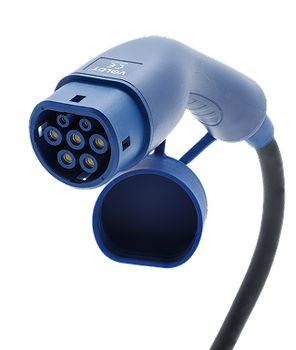
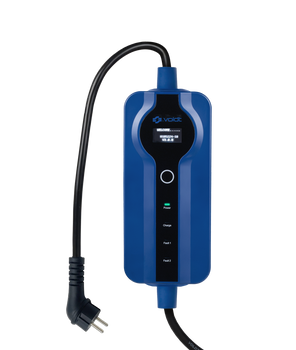
Collection: Citroën ë-C4 X Charging cable

The Citroën ë-C4 X is the fastback sibling of the ë-C4 hatchback, sharing the same e-CMP platform but stretching the roofline into a sleek, coupé-like rear that adds 510 litres of luggage capacity to the electric package. Two battery and motor combinations are available across the range: a 50 kWh (46.3 kWh usable) pack paired with a 100 kW motor and a WLTP range of up to 360 km (224 miles), and a 54 kWh (50.8 kWh usable) version with a 115 kW motor extending range to approximately 420 km (261 miles). Both are front-wheel drive with a top speed of 150 km/h, reaching 0–100 km/h in around 9.5 seconds (100 kW) or 9.0 seconds (115 kW). The standard onboard charger is a 7.4 kW single-phase unit, with an 11 kW three-phase charger available as an option. DC fast charging peaks at 100 kW on all variants. The CCS2 charging port sits on the left rear flank.

AC wallbox charging: what to expect from the Citroën ë-C4 X

The ë-C4 X's charge rate at a wallbox depends on which onboard charger is fitted. Most cars leave the factory with the standard 7.4 kW single-phase charger. Connected to a single-phase 32 A wallbox with the correct cable, the 54 kWh variant charges from empty to full in approximately 7 hours and 35 minutes once typical efficiency losses of around 10 % are included. The smaller 50 kWh battery needs roughly 6 hours and 55 minutes under the same conditions. Both fit comfortably within an overnight window.

Cars equipped with the optional 11 kW three-phase charger are considerably faster at a three-phase wallbox: the 54 kWh battery completes a full charge in around 5 hours and 5 minutes, and the 50 kWh in approximately 4 hours and 40 minutes. On a single-phase home supply, however, the optional 11 kW charger faces a hardware limitation: it is restricted to 16 A per phase. This means that when connected to a standard 7.4 kW (32 A) domestic wallbox, the car can only draw 3.7 kW, regardless of the cable used. At this rate, a full charge takes over 15 hours for the 54 kWh variant and nearly 14 hours for the 50 kWh. For owners with a single-phase home connection, the standard 7.4 kW onboard charger is actually the faster choice for daily domestic charging.

Rapid charging between stops

Both ë-C4 X variants support CCS2 DC rapid charging at up to 100 kW. The 54 kWh battery reaches 10–80 % in approximately 29 minutes, with a full 0–100 % charge taking around 54 minutes once the battery management system's end-of-charge taper is accounted for. The 50 kWh variant is slightly quicker: roughly 26 minutes for 10–80 % and approximately 48 minutes for a full charge. On a longer motorway journey, a single rapid stop of under half an hour is enough to cover the next leg.

Which Type 2 cable suits the Citroën ë-C4 X?

The cable recommendation for the ë-C4 X hinges on which onboard charger is fitted and whether your home supply is single-phase or three-phase.

For the standard 7.4 kW single-phase charger, which is the version most owners will have, a 7.4 kW single-phase Type 2 cable or a 22 kW three-phase cable is the correct choice. Both deliver the full 7.4 kW the car can accept on a 32 A single-phase wallbox. An 11 kW three-phase cable, however, is rated at only 16 A per phase: on a single-phase supply, it limits the charge to 3.7 kW, cutting the effective speed in half. For any ë-C4 X with the standard charger, an 11 kW cable should be avoided as the primary home cable.

For cars equipped with the optional 11 kW three-phase charger, an 11 kW Type 2 cable is the perfect match at public three-phase stations or homes with a three-phase supply. However, if your home has a single-phase supply, the car's charger itself will limit the intake to 3.7 kW. In this case, while a 22 kW cable won't speed up home charging due to the car's internal limit, it remains highly recommended as a versatile option that unlocks the full 11 kW potential at public AC charge points.

A 22 kW cable is the most versatile choice across the range. With the standard 7.4 kW charger, it delivers the full 7.4 kW on any single-phase 32 A wallbox. With the optional 11 kW charger, it unlocks the full 11 kW at three-phase wallboxes and public charge points. The only scenario it cannot improve is single-phase home charging on a car fitted with the optional 11 kW charger, where the car's own hardware limits intake to 3.7 kW regardless of cable. It also future-proofs the purchase for any subsequent vehicle that supports 22 kW AC charging.

Picking the right cable length

The ë-C4 X's charging port is positioned on the left rear flank. Reversing towards the wallbox generally brings the port closest to the charger, which keeps the cable neat and avoids trailing it across walkways.

Voldt® Type 2 cables are available in 4, 6, 8, 10, 15, 20, and 40 metre lengths. A 4 m cable suits a tight home setup where the wallbox sits directly beside the parking space. For most driveways and garages, 6 m covers the distance with room to spare. An 8 m cable is a versatile everyday option for both home and public charge points, while 10 m gives extra reach at public stations where the post may be further from the bay. A 15 m cable handles hotel car parks, longer driveways, and wider parking layouts. The 20 m and 40 m lengths are designed for commercial premises, depots, and specialist installations.

Charging on the move with a portable CEE charger

A Voldt® portable CEE charger extends the ë-C4 X's charging options to any compatible industrial or domestic socket.

With the standard 7.4 kW single-phase charger, the car draws from one phase only, regardless of how many phases the socket provides. At a 32 A three-phase CEE socket (red, five-pin, found at industrial sites and workshops), the car draws 32 A from a single phase for 7.4 kW: a full charge takes approximately 7 hours and 35 minutes for the 54 kWh variant and around 6 hours and 55 minutes for the 50 kWh. At a 16 A three-phase CEE socket, output drops to 3.7 kW (16 A on one phase), raising the full charge time to around 15 hours for the 54 kWh and roughly 13 hours and 45 minutes for the 50 kWh.

Cars with the optional 11 kW three-phase charger draw across all three phases at a red CEE socket. Both 32 A and 16 A three-phase CEE connections deliver the charger's full 11 kW ceiling, bringing the 54 kWh battery to full in approximately 5 hours and 5 minutes and the 50 kWh in around 4 hours and 40 minutes. On a single-phase socket, however, the charger's 16 A per-phase hardware limit applies: output is capped at 3.7 kW, the same as a blue campsite hook-up.

At a blue 16 A single-phase CEE socket, the standard fixture at holiday campsites and caravan parks across Europe, output is limited to 3.7 kW regardless of charger version. The 54 kWh variant needs around 15 hours for a full charge; the 50 kWh, roughly 13 hours and 45 minutes. A full charge requires leaving the car connected continuously for more than half a day, but plugging in on arrival still recovers a useful amount of range over a weekend stay. Red three-phase CEE sockets are not standard campsite infrastructure: they belong to industrial premises, workshops, and some commercial marinas.

From a standard European household socket (Schuko), continuous output is restricted to a safe 2.3 kW (10 A). The 54 kWh variant takes approximately 24 hours and 20 minutes; the 50 kWh, around 22 hours and 10 minutes. With batteries of this size, a domestic socket serves only as an emergency fallback and should not be relied upon for regular use.

Voldt® charging cables are CE, UKCA and TÜV certified and manufactured according to IATF 16949 automotive quality standards. Single-piece moulded connectors, no glue or screws. IP67-rated for operation between −30°C and +50°C. 100% copper conductors with silver-plated contacts. Tested beyond 10,000 connection cycles. Three-year warranty, 100-day returns, free shipping across Europe.